
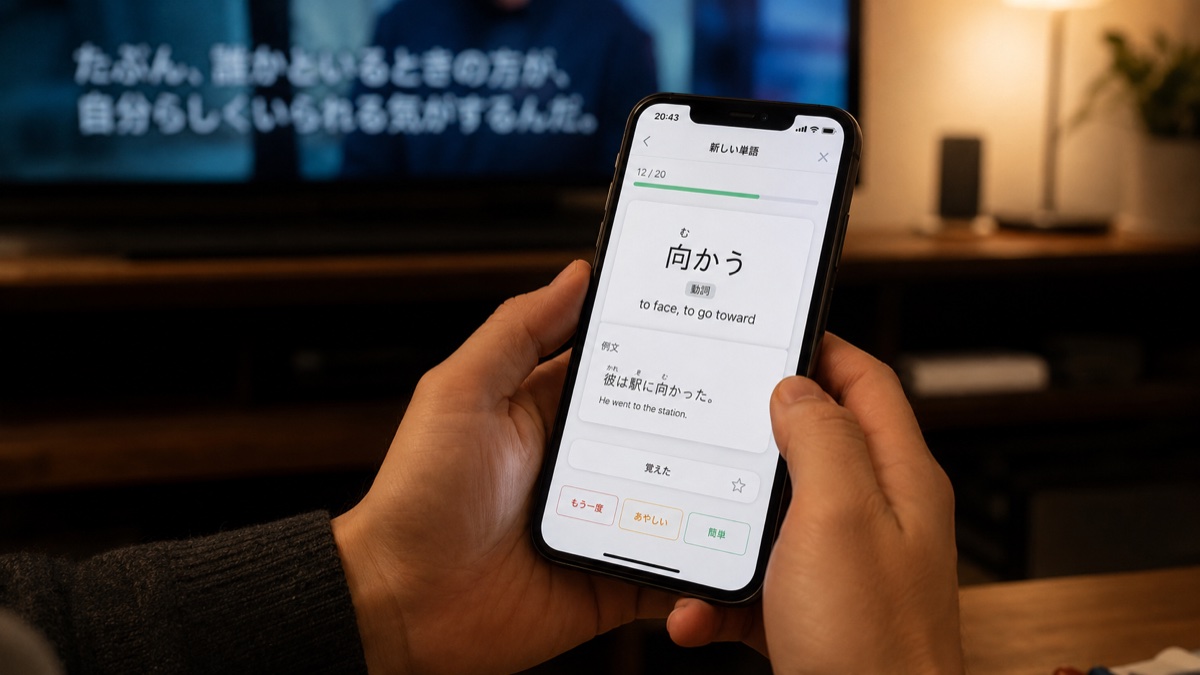
Sentence mining is the practice of taking sentences you encounter while reading or watching — specifically ones you mostly understand but that contain a word, grammar pattern, or phrase you’re still shaky on — and turning them into flashcards for spaced repetition review. It’s the method behind much of the “I learned Japanese from anime” success stories you see on Reddit and YouTube, and it’s a natural fit for Anki sentence mining workflows.
Unlike generic vocabulary lists, every card in a mined deck comes from something you actually watched or read, in context, which makes the cards both easier to remember and directly relevant to your own gaps.
Sentence mining, defined in one sentence
If you only remember one thing from this article, make it this: sentence mining is collecting real sentences from content you enjoy, and reviewing them with spaced repetition until they become automatic.
That’s the whole method. The rest of this guide covers why it works, why it usually breaks down in practice, and how to make it sustainable.
Why sentences beat word lists
Traditional vocabulary lists ask you to memorize a word and its translation — for example, 久しぶり → “long time no see.” This works for simple, one-to-one words, but Japanese is full of words and grammar patterns whose meaning depends heavily on context: particles, verb conjugations, levels of formality, and set phrases that don’t translate cleanly word-for-word.
Sentence mining solves this by keeping the context attached to the word:
- Collocations — which words naturally appear together — are preserved. You learn that a verb is usually followed by a particular particle, not just the verb in isolation.
- Grammar in action — instead of memorizing a conjugation rule abstractly, you see it used in a real sentence, which is how native speakers actually internalize grammar.
- Memory hooks — a sentence tied to a scene from a show you watched, or a line a character said, is far more memorable than an abstract dictionary entry. Your brain has something to attach the new information to.
This is also why comprehensible input flashcards — cards built from material you understood well enough to follow, but not perfectly — tend to outperform decks built from frequency lists or pre-made vocabulary packs. The cards mean something to you before you’ve even reviewed them once.
The traditional (manual) process — and why most people quit
Sentence mining isn’t a new idea — it’s been a staple of language-learning forums for over a decade. The traditional manual process looks something like this:
- While watching or reading, notice a sentence with something you don’t fully understand.
- Pause, and write down or copy the sentence.
- Switch to a dictionary (paper, app, or website) and look up the unfamiliar word or grammar point.
- Switch to a grammar reference if the dictionary entry alone doesn’t clarify the nuance.
- Switch to a flashcard app (commonly Anki) and manually create a new card: front, back, example sentence, sometimes audio.
- Repeat — for every sentence, every episode.
Each of these steps takes only a minute or two on its own. But multiplied across 10-15 sentences per session, and across dozens of sessions, the cumulative friction adds up fast. This is the single biggest reason sentence mining has a reputation for being something people start enthusiastically and abandon within a few weeks — not because the method doesn’t work, but because the manual process is exhausting.
The streamlined process: Netflix + KIKUGO + Anki
This is where the method changes from “a great idea in theory” to something you can actually sustain. If you’re watching Japanese shows on Netflix with Japanese subtitles enabled, KIKUGO collapses steps 2 through 5 of the manual process into a single click.
Here’s the streamlined version:
- You’re watching, with Japanese subtitles on and KIKUGO active.
- A line goes by with something you almost understood.
- You click the subtitle directly in the video.
- KIKUGO shows an instant breakdown — meaning, grammar, nuance — without leaving the page.
- If it’s worth keeping, you save it to your deck with one click.
- Later, export your saved sentences to Anki and review them with spaced repetition.
No dictionary tab, no copy-pasting, no manual card formatting. The mining happens during the episode, not as a separate study session afterward — which is exactly why it’s sustainable. For the full step-by-step walkthrough, including how the Anki export and import work, see From Netflix to Anki: Build a Japanese Sentence Deck While You Watch.
A worked example: from subtitle to flashcard
To make this concrete, here’s what a single mining moment looks like in practice:
- The subtitle: a character says a sentence using a casual contraction you don’t recognize — something that sounds natural in speech but isn’t in your textbook’s vocabulary list.
- The click: you click that line in KIKUGO.
- The explanation: KIKUGO breaks down the sentence — what the contraction is short for, how it’s used in casual speech, and roughly how formal or informal it sounds.
- The save: you save the sentence as-is, with KIKUGO’s explanation attached, to your deck.
- The review: a few days later, the card comes up in Anki. You see the sentence, try to recall the meaning, then check the explanation. Because you remember the scene, the recall is faster than it would be for an unfamiliar word in a generic list.
Multiply this by a handful of moments per episode, and over a few weeks your deck becomes a personalized record of exactly the gaps you’ve been closing — built entirely from things you wanted to watch anyway.
How many sentences per day is enough?
There’s no universal number, but a useful range for most learners is 5 to 15 new sentences per day — roughly what comes up naturally in a single 20-25 minute episode if you’re mining selectively rather than mining everything.
A few guidelines:
- If your “cards to review” pile keeps growing faster than you can clear it, mine fewer new sentences until you catch up.
- If you’re going days without mining anything, you may be choosing content that’s either too easy (nothing stands out) or too hard (everything stands out, so you stop trying).
- Quality over quantity: five well-chosen sentences you genuinely didn’t know are worth more than fifteen you barely needed.
If you’re just getting started with this whole approach — immersion plus mining — our complete guide to learning Japanese with Netflix walks through how to set everything up from scratch, including subtitle configuration and choosing shows at the right level.
Ready to try sentence mining without the manual busywork? Install KIKUGO and click your first subtitle on your next episode.
FAQ
What’s the difference between sentence mining and vocabulary lists? Vocabulary lists present words in isolation, often with a single dictionary translation. Sentence mining captures words inside a real sentence, with the grammar, particles, and tone that go with them — so you learn how the word is actually used, not just what it means.
How many sentences should I mine per day? Most learners find 5-15 new sentences per day, drawn from one episode or chapter, to be a sustainable pace. The exact number matters less than consistency — a small daily deck you actually review beats a huge deck you never open.
Do I need to understand grammar before I start sentence mining? No. Sentence mining works at any level, including absolute beginners — you simply mine simpler sentences. As your level rises, the sentences you naturally pick up become more complex, so the method scales with you automatically.
Can sentence mining replace a textbook? Sentence mining is excellent for vocabulary, natural phrasing, and reinforcing grammar you’ve already been introduced to, but it works best alongside some structured study of grammar fundamentals — especially early on. Think of it as the practice layer on top of a foundation, not a replacement for the foundation itself.
What makes a sentence worth mining? A good rule of thumb: if you understood most of the sentence but one word, particle, or grammar pattern made you pause, it’s worth mining. If you understood it instantly, it won’t teach you much. If you understood almost nothing, the sentence may be too far above your current level to be useful yet.