
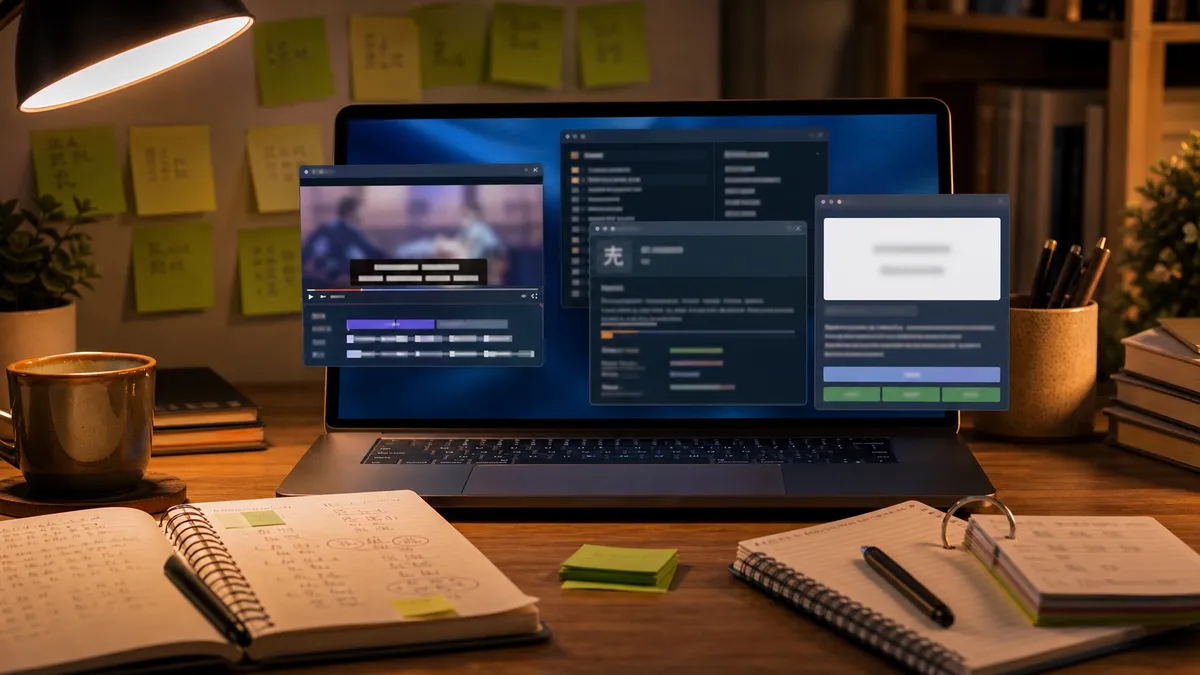
Ask an immersion forum how to mine sentences from anime and the classic answer is the asbplayer Yomitan Anki setup: a free, open-source stack that gives you subtitle control, pop-up dictionary lookups, and spaced repetition. It genuinely works — thousands of learners use it daily. The honest question is not whether it works, but whether you will still be using it in three weeks.
This article lays out what the free stack actually involves, where it shines, and when a one-click tool is the smarter trade.
For the shorter head-to-head version, read KIKUGO vs asbplayer.
What the free stack actually involves
Each piece is excellent at its job:
- asbplayer overlays and controls subtitles on streaming video, with hotkeys to copy the current line.
- Yomitan is a pop-up dictionary: hover a word, get readings and definitions.
- Anki handles spaced repetition, with AnkiConnect bridging the browser to your decks.
Setting it up means: installing three tools plus AnkiConnect, importing dictionary files into Yomitan, configuring a note type with the right fields, mapping asbplayer’s export to those fields, and — for many streaming sites — finding external subtitle files that match your episode’s timing. Budget an evening if everything goes right, longer if it doesn’t.
Once configured, the workflow per card looks like: pause, copy the line with asbplayer, hover words with Yomitan, send to Anki, fix the card formatting, resume watching.
What you get for the effort
Real strengths, worth stating plainly:
- It’s free. No subscription, ever.
- It works beyond Netflix — local video files, other streaming sites, anywhere asbplayer reaches.
- Total control. Your note types, your dictionaries, your card templates.
- Audio on cards. asbplayer can attach the scene’s audio clip to your Anki cards, which the community rightly loves.
If you enjoy owning your system — and some learners genuinely study better because they built the machine themselves — this stack is hard to argue against.
Where it breaks down
The stack’s weak point is not any single tool. It is what happens at the moment of contact with a hard subtitle line.
Yomitan answers word-level questions: what does 諦める mean? But Japanese subtitle lines rarely fail you on one word. They fail on the sentence: what is the そんなこと言われても construction doing, why is the verb in 〜ちゃった form, which part is slang, who is the omitted subject? Hovering four words separately does not add up to understanding the line — that gap is exactly why sentence mining focuses on full sentences in the first place.
The second weak point is friction compounding. Six steps per card is fine on a motivated Tuesday. On a tired Thursday it means you stop making cards, and the deck quietly dies. And the third is maintenance: browser updates, extension permissions, subtitle files that drift out of sync — you are the sysadmin of your study routine.
The KIKUGO trade
KIKUGO collapses the whole loop into one action on Netflix: click the subtitle line, read a full-sentence explanation — grammar, slang, register, the parts Yomitan can’t see — and save it. Export to Anki-ready files whenever you want. No AnkiConnect, no dictionary imports, no external subtitle files.
The trade is real, in both directions:
| Free stack | KIKUGO | |
|---|---|---|
| Price | Free | $10/mo or $72/yr |
| Setup | An evening + maintenance | None |
| Coverage | Any video asbplayer reaches | Netflix |
| Lookup level | Word-by-word | Full sentence explained |
| Steps per card | ~6 | 1 |
If you watch beyond Netflix or refuse subscriptions on principle, the free stack is the right call — it’s what we’d use in your position too. If Netflix is your immersion base and your last three decks died of friction, the math changes: install KIKUGO, use the 10-day trial (no card required), and compare the cards you actually end up with after one week against what your current setup produced.
FAQ
Is the asbplayer + Yomitan + Anki setup free? Yes, completely. All three tools are free and open source. You pay in setup time instead: AnkiConnect, dictionary imports, subtitle files, and wiring the pieces together.
Is KIKUGO better than asbplayer with Yomitan? Neither is strictly better. The free stack offers maximum control and works beyond Netflix; KIKUGO trades that for sentence-level explanations and zero configuration on Netflix. Pick by your tolerance for tinkering.
Do I need external subtitle files with KIKUGO? No. KIKUGO works directly with Netflix’s own Japanese subtitles.
Can I use KIKUGO and Yomitan together? Yes, and it’s a good combination. Yomitan for reading the web, KIKUGO for watching Netflix. They don’t conflict.