
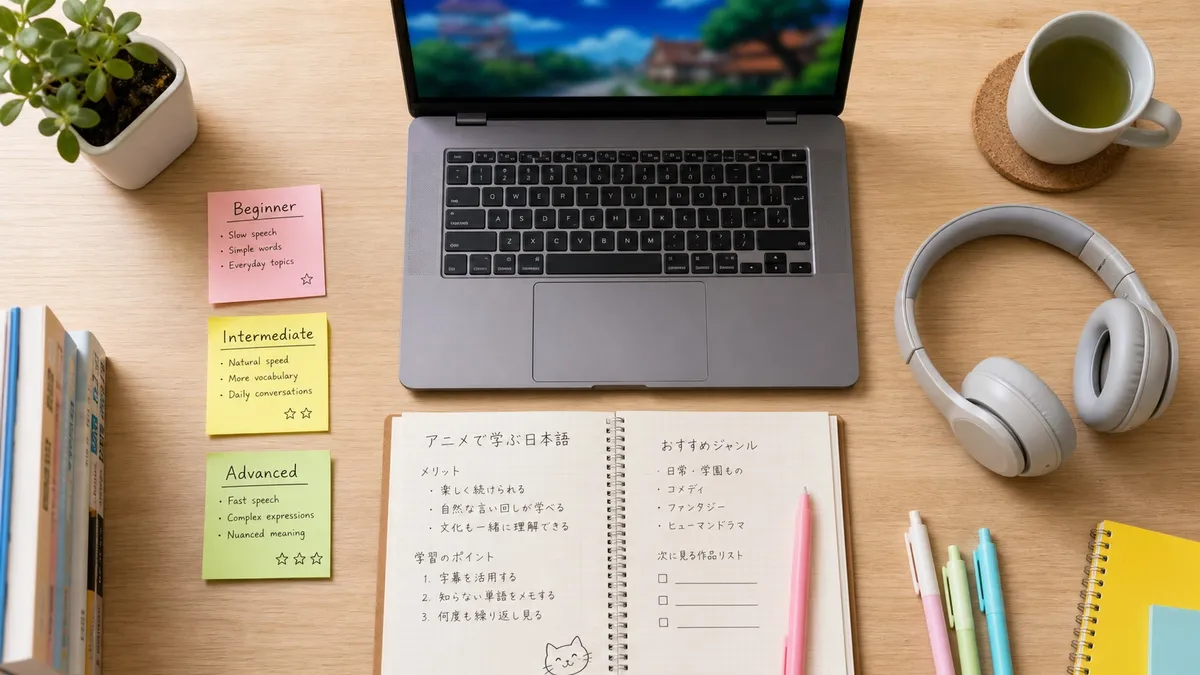
The best anime to learn Japanese is not always the most famous anime. It is the show you can mostly follow, enjoy enough to watch consistently, and mine for useful sentences without pausing every few seconds.
That means a beginner and an advanced learner should not choose the same first show. Beginners need simple, repeated, everyday language. Advanced learners can benefit from fast dialogue, slang, humor, and dense cultural references.
How to choose anime for Japanese study
Before choosing by title, choose by language profile. Ask what kind of Japanese the show will give you.
Good learner-friendly anime tends to have:
- Everyday settings like school, home, clubs, cafes, or small workplaces.
- Repeated character relationships and recurring situations.
- Clear emotional context, so you can infer meaning from the scene.
- Japanese subtitles, especially if you plan to look up or save lines.
Harder anime tends to have:
- Fantasy vocabulary, invented terms, power systems, or historical speech.
- Rapid comedy timing and heavy wordplay.
- Large casts with many speaking styles.
- Formal, archaic, or technical language.
If your main watching happens on Netflix, pair this guide with Best Japanese Shows on Netflix for Language Learners, which focuses on current streaming-style selection by level.
N5-N4: start with slice-of-life and simple comedy
At N5-N4, your goal is not full comprehension. Your goal is recognizing basic grammar and high-frequency phrases in the wild.
Look for:
- School-life or family-life anime.
- Short episodes or calm pacing.
- Repeated greetings, requests, reactions, and simple emotions.
- Visual comedy that helps you follow the story even when you miss words.
Useful patterns at this level include ている, てもいい, たい, から, けど, and simple sentence endings like よ and ね. These patterns show up constantly in everyday dialogue, which makes anime a good reinforcement tool.
Avoid starting with battle shonen or fantasy epics if you are still building the basics. They can be fun, but the vocabulary often gives you less everyday payoff.
N3: choose everyday drama and relationship-heavy shows
At N3, you can handle more natural pacing. This is where anime becomes especially useful because you can follow enough of the story to mine selectively.
Look for:
- Slice-of-life with more complex relationships.
- Workplace or club settings with recurring vocabulary.
- Rom-coms and dramas where emotions are clear but speech is natural.
- Shows you already know in your native language, so plot is not a barrier.
At this level, start saving sentences that contain one new thing: a casual contraction, a useful phrase, or a grammar point you have seen before but still do not fully own.
For example, a line with んだ might teach explanation, emotion, and tone at the same time. Our guide to Japanese grammar from anime gives a pattern checklist you can use while watching.
N2-N1: use anime for nuance, speed, and register
Advanced learners do not need anime to teach basic grammar. They need it for nuance.
Look for:
- Shows with fast, natural conversation.
- Comedy with timing, sarcasm, and implied meaning.
- Adult casts, workplace conflicts, or social tension.
- Dialogue where the same idea appears in formal, casual, and rude registers.
At this stage, your best cards are often not vocabulary cards. They are nuance cards: why this ending sounds pushy, why that slang word works between these friends, or why the translation misses the emotional force of the line.
This is also where Japanese slang becomes useful. Advanced listening depends on recognizing casual speech without automatically copying it into the wrong context.
How to mine anime without ruining the episode
The biggest mistake is trying to mine everything. Anime should stay watchable. If studying destroys the story, you will not continue long enough to benefit.
Use this rule:
- Mine 5 to 10 lines per episode.
- Prefer short, complete sentences.
- Save lines you almost understood, not lines where every word is unknown.
- Review later in Anki instead of rewatching the same scene forever.
KIKUGO is built for this workflow on Netflix. Turn on Japanese subtitles, click a line, get the explanation, save it, and keep watching. When your deck is ready, export the saved sentences to Anki.
For setup help, read How to Turn On Japanese Subtitles on Netflix and From Netflix to Anki. Ready to try it on your next show? Install KIKUGO.
FAQ
What is the best anime to learn Japanese for beginners? The best beginner anime uses everyday settings, short episodes, clear speech, and repeated vocabulary. Slice-of-life, school, family, and gentle comedy series are usually better than fantasy, sci-fi, or battle-heavy shows.
Should I use English subtitles or Japanese subtitles? Use Japanese subtitles when you can follow the general story. English subtitles are helpful for a first watch or difficult scenes, but Japanese subtitles connect the sound to words you can look up and review.
Is anime enough to pass the JLPT? Anime can strengthen listening, vocabulary, and grammar recognition, but JLPT prep also needs reading practice, grammar review, and test-specific exercises. Use anime as input, not your only resource.
How do I know if an anime is too hard? Watch five minutes with Japanese subtitles. If you can follow the situation and only miss some words, it is useful. If every line is confusing, pick something slower or more everyday.