

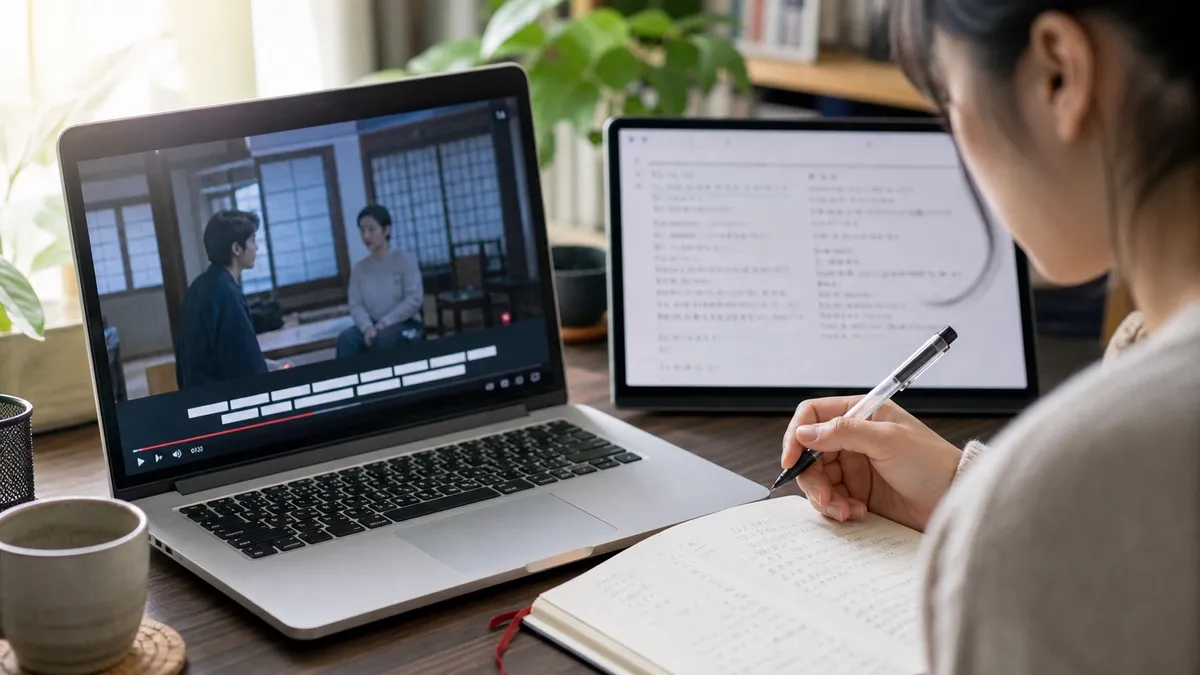
Does Japanese Netflix have English subtitles? Sometimes yes, but not reliably for every title, region, device, or profile language. That is why searches like “Netflix no English subtitles in Japan” and “English subtitles on Japanese Netflix” can lead to different answers: subtitle availability depends on the specific show, licensing, Netflix region, and language settings.
Using English subtitles with Japanese Netflix is not cheating. It is a tool. The problem is using the tool for the wrong job. English subtitles can help you understand the plot, survive a hard first episode, and recover when a scene gets too dense. But if English is always on, it can quietly replace the Japanese you meant to study.
Below you will find 15 Japanese Netflix originals worth trying with English subtitles, step-by-step instructions to turn subtitles on for each device, and a plan for moving from English back to Japanese.
The best strategy is not “never use English”. It is “use English only when it helps you get back to Japanese”. This guide shows when English subtitles are useful, when they slow you down, and how to transition toward Japanese subtitles without making Netflix frustrating. Start with the Japanese subtitles on Netflix setup guide if the Japanese track is not visible yet, or see the full Japanese Netflix subtitles guide for every subtitle scenario.
Quick answer: why English subtitles may be missing
If Japanese Netflix has no English subtitles for a title, the cause is usually availability rather than a broken setting. Netflix can show different audio and subtitle tracks by country, title, and account language. A show may have English subtitles in one region, Japanese subtitles in another, or only translated subtitles for selected languages.
Before changing your study routine, check the exact title’s audio and subtitle menu, then compare it with a second Japanese title. If only one title is missing English, it is probably a title-level availability issue. If every title hides English, check your Netflix profile language and device settings.
Diagnose the title, region, profile, and device
Netflix’s official language-availability guide identifies four variables worth checking: the title, region, profile, and device. Test them in that order so one missing track does not turn into random settings changes.
| Check | What it tells you |
|---|---|
| A second title | Whether the first title simply lacks the English track |
| Your current region | Whether licensing changes the languages available to the account |
| Profile language preferences | Whether English is prioritized in the playback menu |
| A supported desktop browser | Whether the original device is hiding or unable to display a track |
Changing these settings cannot make an unlicensed subtitle file appear. If English is available but the Japanese text does not follow Japanese speech, that is a different problem: read why Netflix Japanese subtitles don’t match the audio before comparing the two scripts word by word.
15 Japanese Netflix Originals to Watch with English Subtitles
How to use this list
Every title below is a Japanese production that Netflix presents as its own, on its Only on Netflix catalog or in its press releases. Subtitle tracks still depend on your region and can change over time, so treat this October 2026 list as strong candidates, not a guarantee. Before you commit to a season, open the Audio & Subtitles menu on the first episode and confirm that English is there.
1. Midnight Diner: Tokyo Stories (2016, drama)
A small back-alley eatery in Tokyo opens from midnight to 7 a.m., and its owner, the Master, cooks whatever his customers ask for. Each episode is named after a dish and runs about 24 minutes. That short format makes it easy to watch a scene once with English, then replay it with Japanese subtitles. Netflix page.
2. The Makanai: Cooking for the Maiko House (2023, drama)
Kiyo, 16, leaves Aomori for Kyoto with her friend Sumire to train as a maiko, is told she is not suited to it, and becomes the cook for the house instead. Hirokazu Kore-eda is the showrunner of the nine-episode series. Many scenes revolve around meals and daily routines, which gives you everyday vocabulary you will hear again in other shows. Netflix page.
3. First Love (2022, romance)
This nine-episode limited series is inspired by two Hikaru Utada songs, “First Love” and “Hatsukoi”. It follows Yae and Harumichi as teenagers in the late 1990s and again two decades later. Because the same characters appear at different ages, it is a good show for comparing how they speak as students and as adults. Netflix page.
4. Love Is Blind: Japan (2022, reality dating)
Marriage-minded singles in Japan date and get engaged before ever seeing each other, talking through a wall in separate pods. As a reality show, it gives you unscripted conversation rather than written dialogue, which is closer to the Japanese you would hear in real life. Use English to follow who is who, then replay the one-on-one pod conversations in Japanese. Netflix page.
5. Alice in Borderland (2020, sci-fi thriller)
Arisu and his friends find Tokyo suddenly empty and must survive deadly games whose difficulty is set by a playing card. Seasons followed in 2022 and 2025, so there is plenty to watch. Every game has rules the players must understand to survive: watch those explanations with English first, then replay them in Japanese once you know what is at stake. Netflix page.
6. Sanctuary (2023, sports drama)
A young delinquent joins a sumo stable as an apprentice, more interested in money than in the sport. Because the eight episodes are set in a sumo stable, it is a good source of sumo vocabulary and of how seniority between wrestlers shapes the way they speak. Save the terms you keep hearing; they tend to come back. Netflix page.
7. Tokyo Swindlers (2024, crime drama)
A crew of real estate fraudsters, with Go Ayano as their negotiator Takumi, chases a 10-billion-yen land scam while the police close in. The seven episodes are adapted from Ko Shinjo’s novel and directed by Hitoshi One. Pay attention to the negotiation scenes, where the crew has to sound credible to buyers: they are a good place to notice polite business Japanese. Netflix page.
8. House of Ninjas (2024, action-spy)
A family of retired ninjas lives an ordinary life until a threat to Japan pulls them back into service. Kento Kaku stars and co-wrote the story, and the series reached No. 1 on Netflix’s global non-English TV list in its second week. The mix of family scenes at home and mission scenes gives you two very different kinds of conversation in the same eight episodes. Netflix page.
9. Yu Yu Hakusho (2023, fantasy action)
This live-action adaptation of Yoshihiro Togashi’s manga follows Yusuke Urameshi, a teenager who dies saving a child and comes back as an Underworld Detective. At five episodes, it is a short commitment. If you already know the anime, the familiar story lets you rely on English less and spend more attention on the Japanese. Netflix page.
10. Call Me Chihiro (2023, drama film)
Kasumi Arimura plays Chihiro, a former sex worker who now runs a bento shop in a seaside town and quietly changes the lives of the people she meets. Netflix co-produced the film with Asmik Ace, and it runs about two hours. A single film is a good fit for a weekend session: watch it once with English, then pick two or three scenes to replay in Japanese. Netflix page.
11. Pokémon Concierge (2023, stop-motion animation)
Haru starts a new job as a concierge at a resort for Pokémon and learns to look after her guests. The first season’s four episodes run roughly 14 to 20 minutes, and four more arrived in 2025. The Japanese voice cast includes Non as Haru. The short episodes and hospitality setting make it an easy first show, and a good place to listen for the polite language staff use with guests. Netflix page.
12. Aggretsuko (2018, anime comedy)
Retsuko, a 25-year-old red panda, works as an accountant at a trading company and vents her frustration with death metal karaoke after work. Most of the early seasons take place in the office, with a demanding boss and a cast of coworkers. Compare how Retsuko talks to her boss with how she talks to her friends: the contrast is a practical lesson in politeness levels. Netflix page.
13. PLUTO (2023, anime mystery)
Based on Naoki Urasawa’s manga, itself a reworking of an Astro Boy story arc by Osamu Tezuka, PLUTO follows Europol robot inspector Gesicht as he investigates the murders of the world’s most advanced robots. As a detective story, it moves from one interview to the next, so it suits intermediate learners. Use English for the plot the first time, then rewatch the key interviews in Japanese. Netflix page.
14. Asura (2025, family drama)
Hirokazu Kore-eda’s seven-episode series remakes Kuniko Mukōda’s 1970s drama. In 1979 Tokyo, four sisters discover that their father has been having a long affair and agree to keep it from their mother. With four sisters at its center, it is a good source of family dialogue once you can follow the basic plot. Netflix page.
15. The Days (2023, disaster drama)
This eight-episode limited series retraces the 2011 Fukushima Daiichi nuclear disaster from three perspectives: the government, the plant operator, and the workers on site. Koji Yakusho plays a character modeled on the plant manager. With storylines inside the government and the plant operator, it is an advanced pick full of technical vocabulary: keep English on for context and save only the Japanese lines you can reuse. Netflix page.
When a title has no English subtitles
Rather than a list of titles without English, which would go stale quickly and varies by country, here are the cases Netflix’s language-availability guide describes:
- Licensed titles. Content licensing and show agreements can limit which languages a title offers.
- Older seasons. Languages for seasons Netflix offered before 2018 may not be available.
- Weekly releases. For licensed shows released week by week, language options appear once they are completed.
To browse titles by subtitle language instead of guessing, use netflix.com/browse/subtitles.
How to Turn On English Subtitles on Japanese Netflix
The menu is the same everywhere: it is called Audio & Subtitles, or 音声および字幕 (onsei oyobi jimaku) if your Netflix interface is in Japanese. The steps below follow Netflix’s subtitle and audio guide.
On a smart TV or streaming device
- Start playing the title.
- Press the up or down arrow on your remote. On Apple TV, swipe up or press the up arrow.
- Select Audio & Subtitles (音声および字幕). On some TVs, the language options appear at the bottom of the screen without the icon.
- Choose English in the subtitle list. If it is not shown, select Other (その他) to see every language the title offers.
When you later switch to Japanese subtitles, note that Netflix says Japanese subtitles may not display on devices made before 2014.
On iPhone and iPad
- Start playing the title in the Netflix app.
- Tap the screen.
- Tap Audio & Subtitles (音声および字幕).
- Choose English, or tap Other (その他) to see the full list.
Downloaded titles show only the two most relevant languages. If English is missing from a download, delete it and choose your subtitle language again.
On Android phone and tablet
- Start playing the title in the Netflix app.
- Tap the screen.
- Tap Audio & Subtitles (音声および字幕).
- Choose English, or tap Other (その他) to see the full list.
The same two-language limit applies to downloads on Android: delete the download and choose your subtitle language again if English is missing.
In a web browser
- Start playing the title on netflix.com.
- Click the screen to show the player controls.
- Click Audio & Subtitles (音声および字幕).
- Choose English, or click Other (その他) to see the full list.
A browser on a computer is also the quickest way to check whether a missing track is a device problem: if English appears there but not on your TV, the title has it.
If English subtitles are missing
- The title does not offer English. Open a second Japanese title. If English appears there, the first title lacks the track. Fix: pick another title or browse netflix.com/browse/subtitles.
- Your location. Available languages depend on the country you are watching from. Fix: no setting adds a track that is not licensed in your region, so check the title’s menu before you start a season.
- Your profile language preferences. The languages Netflix offers first depend partly on your profile settings. Fix: open netflix.com/settings/language, choose English in “Audio and subtitle languages”, then select Save.
- Your device or a download. Some devices, especially ones made before 2014, cannot display every subtitle language, and downloads keep only two languages. Fix: try the title in a web browser, or delete the download and choose English again.
What English subtitles are good for
English subtitles are good for context. They tell you what is happening when the Japanese is too fast, too idiomatic, or too full of names and plot details.
Use English subtitles when:
- starting a new show and learning the premise;
- a key plot scene is impossible to follow;
- a joke or emotional line depends on context;
- you are rewatching a scene and want to confirm the gist;
- you are too tired for Japanese-only immersion but still want exposure.
That last point matters. A tired learner who watches one episode with Japanese audio and occasional English support is still doing more than the learner who skips the session completely.
What English subtitles are bad at
English subtitles are weak as a Japanese study source because they are translations. They are meant to create a smooth viewing experience, not to mirror every particle, verb ending, or omitted subject in the Japanese.
That means English subtitles can hide exactly the parts you need to learn:
- the grammar pattern that made the sentence work;
- the casual contraction a character used;
- the level of politeness;
- the difference between literal meaning and natural translation;
- the word order and emphasis of the Japanese line.
If you rely only on English, you may finish a season with a clear memory of the plot and very little memory of the Japanese.
For a Japanese-first method, read How to Learn Japanese with Netflix.
The ladder method: English to Japanese subtitles
Use English as the bottom rung of a ladder, not as the destination.
Try this sequence:
- Watch a scene with Japanese audio and English subtitles if you need story context.
- Rewatch the same scene with Japanese subtitles.
- Pause only on lines that almost make sense.
- Click useful lines with KIKUGO and save them.
- Rewatch once more without reading English.
This makes English useful because it clears the fog. Once you know what is happening, Japanese subtitles become easier to process.
If you want Japanese and English visible at the same time, read How to Use Dual Subtitles for Japanese on Netflix. Just keep the same rule: Japanese first, English second.
Beginner strategy: when English is allowed
If you are at N5 or early N4, Japanese-only Netflix can feel brutal. You may not know enough grammar or vocabulary to follow even simple scenes. English can help, but set boundaries.
A beginner-friendly rule:
- Use English for the first episode of a show.
- Switch to Japanese subtitles for repeated scenes or short clips.
- Mine only short lines with one clear learning point.
- Keep each session under 30 minutes.
At this stage, the win is not perfect immersion. The win is building a routine where Japanese audio and subtitles become familiar instead of intimidating.
Pair this with easy titles from Best Japanese Shows on Netflix for Language Learners.
Intermediate strategy: English after Japanese
At N3 and above, reverse the order. Try Japanese first. Only check English after you have made a real attempt.
The intermediate routine:
- Watch with Japanese subtitles.
- Rewind if a line matters.
- Guess the meaning from context.
- Check English only if the scene is still unclear.
- Save the Japanese line if the explanation teaches something.
This protects your attention. Your brain has to wrestle with Japanese before it receives the translation.
At this level, the most valuable lines are usually not the hardest lines. They are the lines just above your level: familiar structure, one new phrase, clear context.
Advanced strategy: English as a spot check
Advanced learners can keep English off almost all the time. Use it only as a spot check for:
- idioms;
- wordplay;
- slang;
- culturally loaded references;
- emotionally subtle lines.
Then return to Japanese immediately. If the line is useful, save it. If it was just a plot detail, let it go.
For casual expressions that subtitles translate loosely, read Japanese Slang and Casual Speech You Won’t Learn from Textbooks.
How KIKUGO helps you leave English behind
The reason learners cling to English is simple: they need explanations. If Japanese subtitles are just lines of text you do not understand, English feels safer.
KIKUGO gives you another option. Click the Japanese subtitle line and get a sentence-level explanation in context. The Japanese subtitle explanations feature shows what that workflow returns before you install it. That means you can use Japanese subtitles more often without feeling stranded.
Instead of moving from Japanese to English, you move from Japanese to explanation to review. That is a much better loop for learning.
Ready to make Japanese subtitles less intimidating? Install KIKUGO and try the ladder method on one scene tonight.
FAQ
Can I learn Japanese with English subtitles on Netflix? Yes, but only if English subtitles are a temporary support. If you read English for the whole episode, you mainly train plot comprehension. Use English to restore context, then return to Japanese audio and subtitles.
When should I use English subtitles? Use English subtitles for the first episode of a new show, difficult plot scenes, or after you have already tried to understand a line in Japanese. Avoid making English the default for every scene.
When should I switch to Japanese subtitles? Switch to Japanese subtitles as soon as you can follow the basic scene. You do not need perfect understanding; you only need enough context to keep Japanese as the main input.
Are English subtitles accurate for Japanese learning? They are useful for meaning, but they are often translations rather than word-for-word matches. Treat them as context, not as a grammar explanation of the Japanese sentence.