
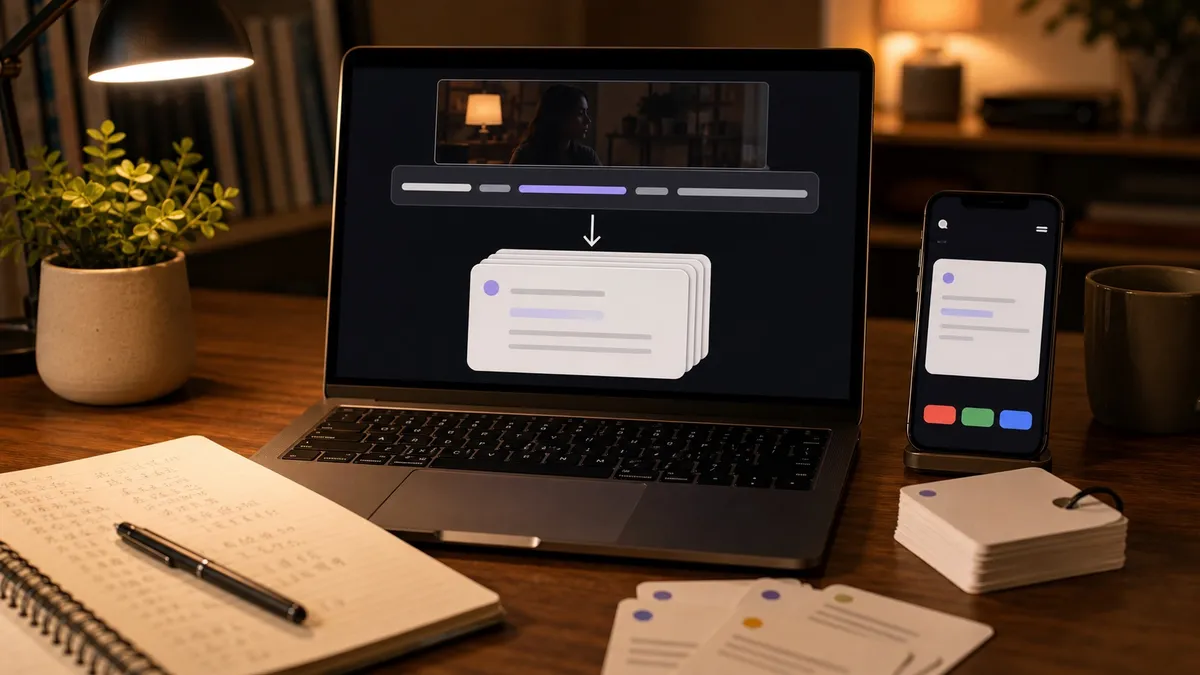
Good Japanese Anki sentence cards are not just vocabulary cards with longer text. They are small pieces of real Japanese that preserve context: grammar, particles, tone, and the scene that made the line memorable.
The trick is choosing the right lines. A sentence card should teach one useful thing, not overwhelm you with five unknown grammar points at once.
Quick answer
A strong sentence card has:
- one real Japanese sentence;
- one main learning target;
- a clear explanation;
- enough context to remember the line;
- no extra clutter.
If your source is Netflix, the full workflow is in From Netflix to Anki.
What makes a sentence worth saving?
Save sentences you almost understand. If the line is too easy, it will not teach you much. If it is too hard, it becomes a translation puzzle.
The best line has one gap: one word, one particle, one casual contraction, or one grammar pattern. That is the same idea behind an i+1 sentence in Japanese sentence mining.
What to avoid
Avoid cards that are too long. Avoid cards with five unknown words. Avoid saving every line because you are afraid of missing something.
Anki punishes clutter. Every unnecessary detail becomes review friction later.
Your deck should feel like a trail of useful moments from shows you watched, not a database of everything you failed to understand.
How KIKUGO helps
Manual cards take time: copy the sentence, look up words, write notes, format the card, and hope you captured the nuance correctly.
KIKUGO makes the card from the moment of understanding. You click the Netflix subtitle line, read the sentence explanation, save it, and export later. That gives you cards that are connected to real listening practice, not isolated word lists.
For the method behind this, read What Is Sentence Mining?.
Ready to build a cleaner deck? Install KIKUGO, watch one episode, and save only the lines you would actually want to review tomorrow.
FAQ
What should be on a Japanese Anki sentence card? A good card should include the Japanese sentence, enough explanation to understand it, and optionally a short translation or note. Keep the card focused on one useful gap.
Are sentence cards better than vocabulary cards? Sentence cards are often better for real Japanese because they preserve particles, grammar, nuance, and context. Vocabulary cards can still help, but isolated words are easier to forget.
How many Japanese Anki sentence cards should I add per day? Most learners do better with 5-15 useful cards per day than with large batches. The goal is sustainable review, not collecting every sentence.