
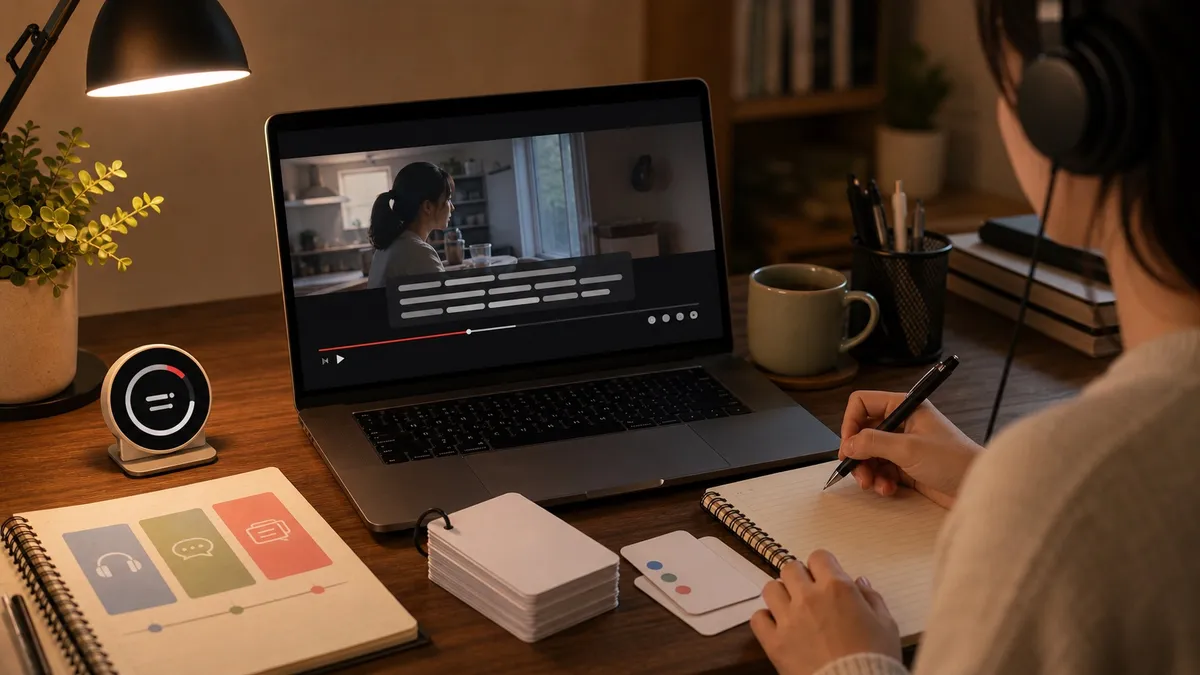
Good Japanese listening practice with subtitles is not passive watching. It is a loop: listen, check, understand, save, review. Subtitles help only when they make the spoken Japanese clearer instead of replacing it with English.
Netflix is useful because one scene can give you audio, visual context, Japanese subtitles, and real dialogue. KIKUGO adds the missing layer: sentence explanations and reviewable cards.
Quick routine
Use this structure:
- Watch a short scene without pausing.
- Replay with Japanese subtitles visible.
- Pick lines you almost understood.
- Click each line with KIKUGO.
- Save 5-10 sentences.
- Review them later in Anki.
If you need the setup first, start with How to Learn Japanese with Netflix.
Why subtitles help listening
Japanese listening is hard because sounds blur together. Subtitles let you map the audio back to real words, particles, and sentence endings.
The danger is relying on subtitles too much. If your eyes do all the work, listening stalls. The fix is simple: listen first, read second, replay third.
This is also why Japanese subtitles on Netflix are more useful than English subtitles for study.
What makes a line worth saving?
Save a line when it is close to your level. If you understood nothing, it is too hard. If you understood everything instantly, it is not worth a card.
The best line is the one with one clear gap: a new word, a grammar pattern, a contraction, or a phrase that sounded natural but surprising. That is the same logic behind Netflix to Anki sentence mining.
How KIKUGO keeps the routine light
Without a tool, listening practice becomes tab switching: pause, copy, search, write, format, review. Most learners eventually stop doing that.
With KIKUGO, you click the subtitle line, read the sentence explanation, save it, and keep watching. That keeps the study layer small enough to repeat.
To turn clearer listening into interaction, use the lines in Japanese conversation practice: shadow them, adapt them to your own life, then bring them into a live exchange.
Compare active and passive Japanese immersion when background exposure begins to replace attention, and train reductions, reactions, and casual Japanese conversation through short repeated scenes.
Install KIKUGO, try one 20-minute session, and judge the routine by the number of useful cards you actually review tomorrow.
FAQ
Is listening with subtitles good for Japanese? Yes, if you use subtitles actively. Listen first, check the Japanese line, understand what you missed, and save only useful sentences for review.
Should I use English or Japanese subtitles? Use Japanese subtitles for study whenever possible. English subtitles can help orientation, but Japanese subtitles connect sound, grammar, and written forms.
How long should a listening practice session be? Fifteen to twenty minutes is enough if the routine is focused. One short scene with five saved sentences can beat an hour of passive watching.