
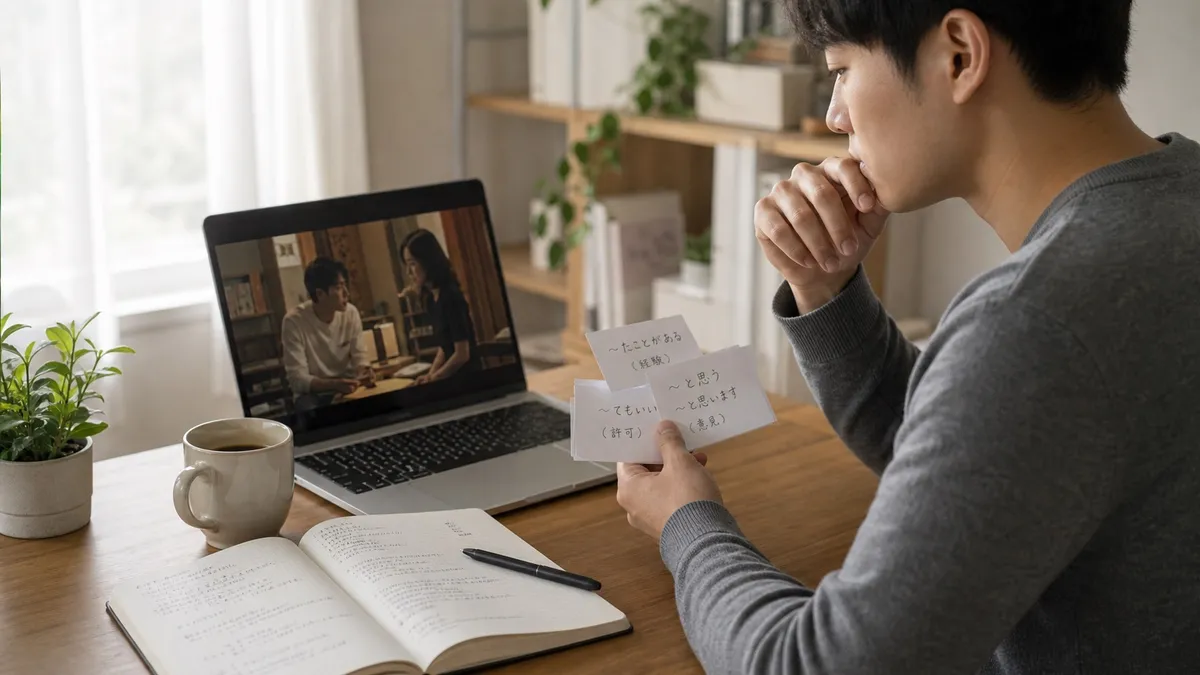
Search for learn Japanese from anime effectiveness and you will find two extreme answers: yes, anime can teach you everything, or no, it is just procrastination with subtitles. The honest answer sits in the middle. Netflix and anime can absolutely help you learn Japanese, but only when watching becomes active enough for your brain to notice, understand, and review new language.
In other words: Netflix is powerful input. It is not a complete method by itself.
The short answer
You can learn Japanese from Netflix if the shows are close enough to your level and you pair watching with active review. You probably will not learn efficiently if you only watch with English subtitles, never pause, never look anything up, and never review what you heard.
This is the difference between exposure and learning. Exposure gives your brain raw material. Learning happens when some of that material becomes comprehensible, memorable, and repeated.
If kana is still slow, start with Hiragana Practice and the Hiragana Quiz before you make Netflix your main input source. If you want the practical setup first, read How to Learn Japanese with Netflix. This article focuses on what Netflix can and cannot do.
What input does well
Japanese has rhythm, reductions, particles, sentence endings, and social nuance that are hard to absorb from isolated textbook examples. Native-speed shows give you those patterns in motion.
Good input helps with:
- Listening stamina, because your ear gets used to real speed.
- Common vocabulary, because frequent words repeat across scenes.
- Natural phrasing, because you hear which words actually appear together.
- Grammar intuition, because forms like んだ, てる, and かも appear again and again.
This is why learners who only study from textbooks often feel shocked by their first drama or anime episode. They know facts about Japanese, but they have not heard enough Japanese behaving naturally.
What passive watching misses
Passive watching feels productive because you are surrounded by Japanese. Sometimes that is enough for review or maintenance. But if most of the episode is incomprehensible, your brain has little to attach meaning to.
The biggest failure modes are simple:
- English subtitles pull your attention away from Japanese.
- Shows that are too hard create noise, not useful input.
- New words disappear because you never see them again.
- Grammar points stay vague because you never stop to confirm them.
This does not mean you should pause every ten seconds. It means you need a light active layer. Even five useful saves from one episode can change the value of the session.
Active immersion: the missing ingredient
Active immersion means you still watch real content, but you interact with it just enough to learn from it.
A strong active session might look like this:
- Watch with Japanese audio and Japanese subtitles.
- Follow the story without trying to understand every word.
- Click or pause on lines you almost understand.
- Save only the sentences that teach one useful word, grammar point, or phrase.
- Review those sentences later with spaced repetition.
That workflow is exactly what sentence mining is for. Instead of building a deck from generic word lists, you build it from your own input.
KIKUGO makes this easier on Netflix: click a Japanese subtitle, read the explanation, and save the line for Anki export. The point is not to interrupt the episode. The point is to make the best lines reusable.
What about output and speaking?
Netflix is mostly input. That is a strength, but it also means it will not train every skill equally.
Watching helps you understand. It does not automatically make you speak smoothly, write correctly, or handle live conversation. For that, you eventually need output: shadowing, journaling, conversation practice, tutoring, or language exchange.
But input still matters before output. The more natural examples you have heard, the less you have to invent Japanese from English. You start remembering how a phrase sounded in a scene instead of assembling it word by word.
If you are deciding whether those hours justify the effort, is learning Japanese worth it? compares media, career, travel, and relationship outcomes without pretending Netflix develops every skill.
A realistic routine
For most learners, the sustainable version is not a heroic four-hour immersion block. It is a small loop repeated often:
- Review Anki for 10 to 15 minutes.
- Watch one episode or half an episode with Japanese subtitles.
- Save 5 to 10 sentences that are close to your level.
- Stop before the process feels like punishment.
If you need titles at the right difficulty, use Best Japanese Shows on Netflix for Language Learners or Best Anime to Learn Japanese. If you are ready to make subtitles clickable, install KIKUGO before your next episode.
FAQ
Can I learn Japanese just by watching Netflix? You can learn a lot from Netflix, especially listening rhythm, vocabulary, and natural phrasing, but passive watching alone is usually too weak. The strongest routine combines comprehensible input with active lookup, sentence mining, and spaced review.
Is passive immersion a waste of time? No. Passive immersion still builds familiarity with sounds, rhythm, and common words. It becomes much more powerful when some of that watching is active: Japanese subtitles, quick lookups, and a small number of saved sentences.
How many hours should I watch per week? A realistic starting point is three to five focused hours per week, plus ten to fifteen minutes of daily flashcard review. Consistency matters more than long binge sessions.
Do I still need grammar study? Yes, especially at beginner and lower-intermediate levels. Grammar study gives you the map; immersion gives you repeated real examples; sentence mining connects both.