
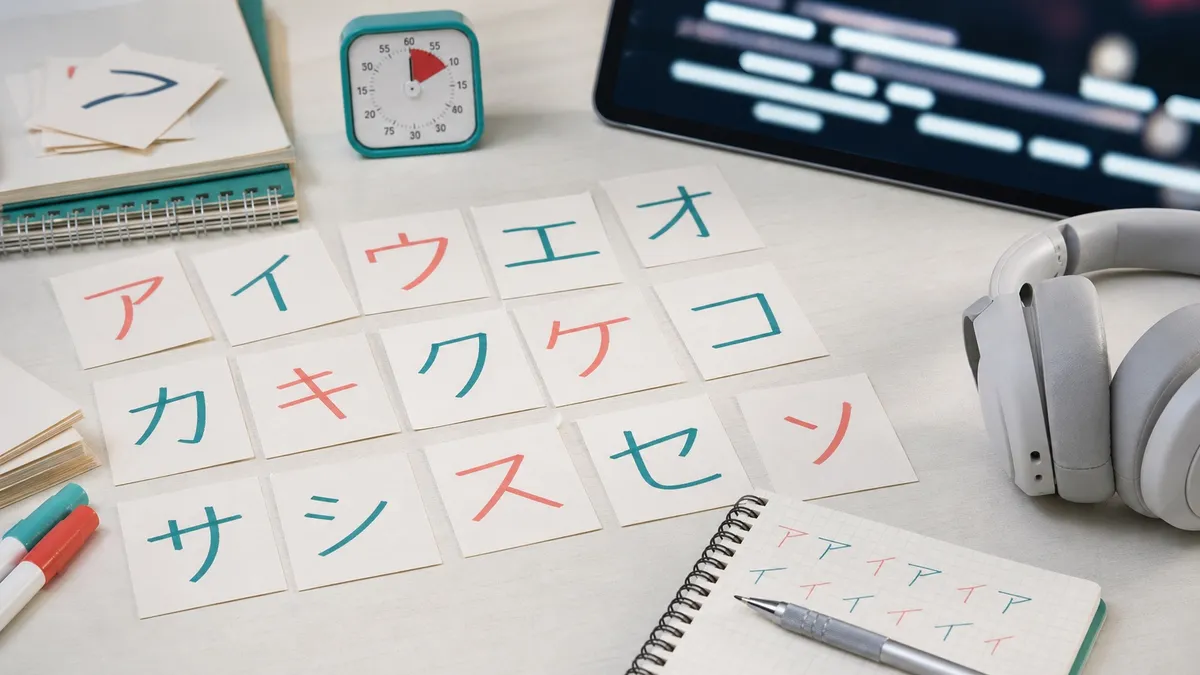
Effective katakana practice is not copying the chart until your hand hurts. It is learning to recognize angular symbols, sound changes, and loanword chunks quickly enough that one katakana word does not derail an entire Japanese subtitle.
If you know the chart but still pause on コンビニ or メール, you do not need to relearn katakana from zero. You need retrieval practice in increasingly realistic chunks.
Direct Answer: How Should You Practice Katakana?
Use four layers: single-character recall, confusing-pair contrasts, sound-pattern drills, and short words inside real sentences. Practice for 10–15 minutes daily, then test whether you can read one subtitle line without switching back to romaji.
The Japan Foundation now offers dedicated Hiragana and Katakana A1 self-study courses built around reading, typing, and simple words and phrases. That progression is useful: isolated recognition is the start, not the finish.
The 15-Minute Katakana Routine
| Time | Drill | Goal |
|---|---|---|
| 3 minutes | random single cards | recall the sound without chart order |
| 3 minutes | confusing pairs | notice stroke direction, not overall silhouette |
| 4 minutes | sound patterns | read long vowels, small ッ, and combined sounds |
| 3 minutes | short loanwords | recognize chunks instead of spelling symbol by symbol |
| 2 minutes | one subtitle line | transfer practice into context |
Keep a tiny miss list. Tomorrow’s session should begin with yesterday’s three slowest items, not the entire chart.
Drill the Pairs That Cause Hesitation
| Pair | Fast visual cue | Practice contrast |
|---|---|---|
| シ / ツ | direction of the short strokes | シーツ |
| ソ / ン | direction and starting angle | ソン |
| ク / ケ | ケ has an extra stroke | ク / ケ |
| ワ / ウ | ウ has a top stroke | ワ / ウ |
| フ / ラ | different opening and final stroke | フラ |
Do not memorize these as verbal descriptions alone. Put the pair side by side, say both sounds, cover them, and redraw or select the correct one from memory.
Use the Katakana Quiz to diagnose weak pairs, then return here for repeated practice. A quiz tells you what failed; practice changes what happens next time.
Practice the Sound Patterns, Not Just the Symbols
Katakana words often become difficult because of spelling conventions rather than unknown characters.
Long vowel mark: ー
- コーヒー — koohii, coffee
- メール — meeru, email
- ゲーム — geemu, game
Hold the previous vowel. Do not pronounce ー as a separate sound.
Small ッ: doubled consonant
- ベッド — beddo, bed
- チケット — chiketto, ticket
- ネット — netto, internet/net
The small ッ creates a short pause before the next consonant. Read the rhythm, not only the letters.
Combined sounds: small ャ, ュ, ョ
- シャツ — shatsu, shirt
- ニュース — nyuusu, news
- チョコ — choko, chocolate
Read each combination as one mora-sized unit: シャ is sha, not shi-ya.
Learn High-Value Subtitle Chunks
Practice words that appear across everyday dialogue rather than obscure dictionary items.
| Katakana | Reading | Meaning |
|---|---|---|
| スマホ | sumaho | smartphone |
| コンビニ | konbini | convenience store |
| アルバイト | arubaito | part-time job |
| メッセージ | messeeji | message |
| プレゼント | purezento | present/gift |
| タイミング | taimingu | timing |
| チャンス | chansu | chance |
| ルール | ruuru | rule |
Then place one word in a short line. For example, メッセージを見た? combines a katakana noun with a hiragana particle and a kanji verb. Mixed-script reading is the real target.
The broader Japanese Alphabet guide explains how katakana shares a sentence with hiragana and kanji. If hiragana is still slower, return to Hiragana Practice before adding more words.
A Simple Speed Check
Choose ten katakana words you have already studied.
- Read them in a fixed order and record the time.
- Shuffle them and read again.
- Put five into short Japanese sentences.
- Test the same set tomorrow without warm-up.
Chart-order speed can hide weak recall. Shuffling and sentence context show whether the symbols are genuinely available while you read.
Move From Practice to Subtitles
During a show, pause only when a katakana word sits inside a line you mostly understand. Read the word aloud, identify its original concept, and then reread the whole line. Save it only if the sentence is worth meeting again.
Use the Learn Japanese with Netflix hub for the full watching routine and Netflix Japanese Flashcards to keep useful sentences in context.
Source
Install KIKUGO when you want one difficult subtitle line explained and saved without interrupting the whole episode.
FAQ
What is the best way to practice katakana? Practice in layers: recall single symbols, contrast confusing pairs, read sound patterns such as long vowels and small tsu, then decode short loanwords in real sentences.
Why is katakana harder than hiragana to remember? Many learners encounter katakana less often, so recognition receives less repetition. Similar angular shapes also expose hesitation when reading at subtitle speed.
How much katakana practice should I do each day? Ten to fifteen focused minutes is enough when it combines recall, word chunks, and one real subtitle line. Frequent short sessions usually beat occasional cramming.