
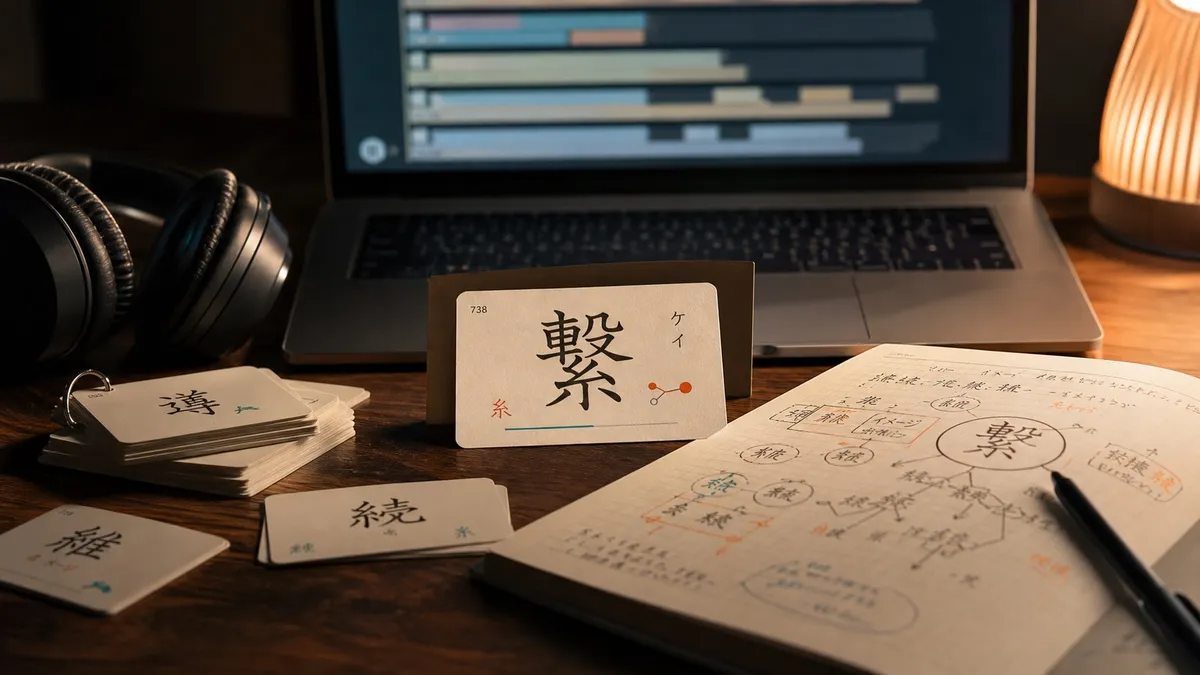
You can learn kanji from Japanese subtitles, but subtitles are strongest as a source of context and repetition, not as a random replacement for a structured kanji path. The scene gives a character a voice, intention, and memorable consequence; your study method still has to isolate what is worth retaining.
The goal is not to mine every unknown character. It is to recognize a useful kanji inside a useful word, understand the complete line, and meet that same pattern again in review.
Direct Answer: Can Subtitles Teach You Kanji?
Yes. Use subtitles to reinforce kanji you are ready to learn: choose a line you mostly understand, identify one recurring character inside a word, confirm its reading and meaning, then save the whole sentence. Combine this with a level-based kanji foundation so your exposure is cumulative rather than random.
Why Context Helps
A kanji card that contains only 行 = go hides important information. In real Japanese, 行 appears inside words and forms such as 行く, 行った, 銀行, and 旅行, with different readings and meanings.
A subtitle line narrows the choice:
今日は学校に行かない。
The scene and grammar tell you that 行 is part of 行かない, “will not go.” The same line also reinforces 今日 and 学校. You are learning a network of word, reading, grammar, and situation rather than an English keyword attached to a shape.
The Five-Part Kanji Note
For each saved line, record only what you will use:
| Field | Example | Purpose |
|---|---|---|
| Target word | 行かない | preserves the actual form |
| Reading | いかない | makes recall pronounceable |
| Core meaning | not go / won’t go | fits this sentence |
| Full line | 今日は学校に行かない。 | preserves grammar and context |
| One cue | speaker refuses to go to school | recovers the scene |
Do not add every possible reading of 行 to this card. A separate structured resource can organize readings; the subtitle card should preserve this encounter.
Choose the Right Subtitle Line
Save a line when:
- you understand most of it already;
- one kanji or word is the main gap;
- the sentence is short enough to reread quickly;
- the scene makes the meaning memorable;
- the word is likely to matter again.
Skip a line when it contains several unknown grammar patterns, a wall of proper names, or a joke that requires a paragraph of cultural explanation. Difficulty is not the same as value.
If you are starting, use the N5 Kanji List for Netflix Subtitles as a priority map. Move to the N4 Kanji List when everyday scenes begin repeating a wider range of actions, places, and relationships.
A Three-Pass Learning Routine
Pass 1: Recognize
Watch the scene, replay the line, and circle the word containing the target kanji. Say the whole word aloud. Recognition comes before perfect production.
Pass 2: Retrieve
Later, look at the Japanese line without the English meaning. Try to recover the word reading, the sentence meaning, and the scene. Reveal the answer only after making an attempt.
Pass 3: Reuse
Find the same kanji in another word or sentence. Compare what stayed stable and what changed. One contrast is more useful than copying ten dictionary compounds you have never encountered.
How Many Kanji Do You Need Before Starting?
There is no useful minimum total for beginning subtitle study. Learn both kana systems first, then start with simple lines and a small kanji base.
Japan’s MEXT learning handbook explains that roughly 2,000 kanji are used in daily life and studied over years in Japanese schools. Treat that number as the scale of long-term literacy, not a gate you must clear before watching.
The Japanese Alphabet guide shows how kanji interact with hiragana endings and katakana words. That mixed-script view matters because a kanji’s grammatical role often becomes visible only through the kana around it.
What Research Can and Cannot Tell Us
Research on second-language video learning is not a Japanese-kanji guarantee. However, an experimental study published in Studies in Second Language Acquisition found that captioned groups improved target vocabulary more than a non-captioned control in its L2 setting. A 2022 research review also describes on-screen text as relevant to vocabulary, grammar, listening, and comprehension.
The reasonable inference is narrow: visible language can support noticing and vocabulary learning when paired with understandable audiovisual input. It does not prove that passive watching will teach Japanese orthography. Retrieval and review still matter.
Keep the Deck Sustainable
Start with one to three subtitle lines per day. Remove cards that remain incomprehensible after explanation. If reviews grow faster than useful viewing, save fewer lines.
Use the Japanese Sentence Mining hub for the full capture-to-review workflow and Netflix Japanese Flashcards for contextual cards. The winning deck is not the biggest one; it is the one you can keep reviewing while continuing to watch.
Sources
- Japan’s Ministry of Education: Japanese Learning and Life Handbook
- Cambridge University Press: captions and L2 grammar/vocabulary study
- Cambridge University Press: review of audiovisual input and on-screen text
Install KIKUGO when you want to explain one mostly understandable subtitle, save the full line, and export it for review.
FAQ
Can you learn kanji from Japanese subtitles? Yes, subtitles can reinforce kanji through repeated words and memorable scenes, but they work best alongside a structured foundation rather than as your only source of characters.
Should I learn kanji alone or in sentences? Learn the character inside a useful word, then preserve one short sentence that shows its reading and meaning. Isolated character study can support recall, but sentences make usage easier to recover.
How many subtitle sentences should I save each day? Start with one to three lines that are mostly understandable and contain one useful kanji gap. Saving fewer, better sentences keeps review sustainable.