
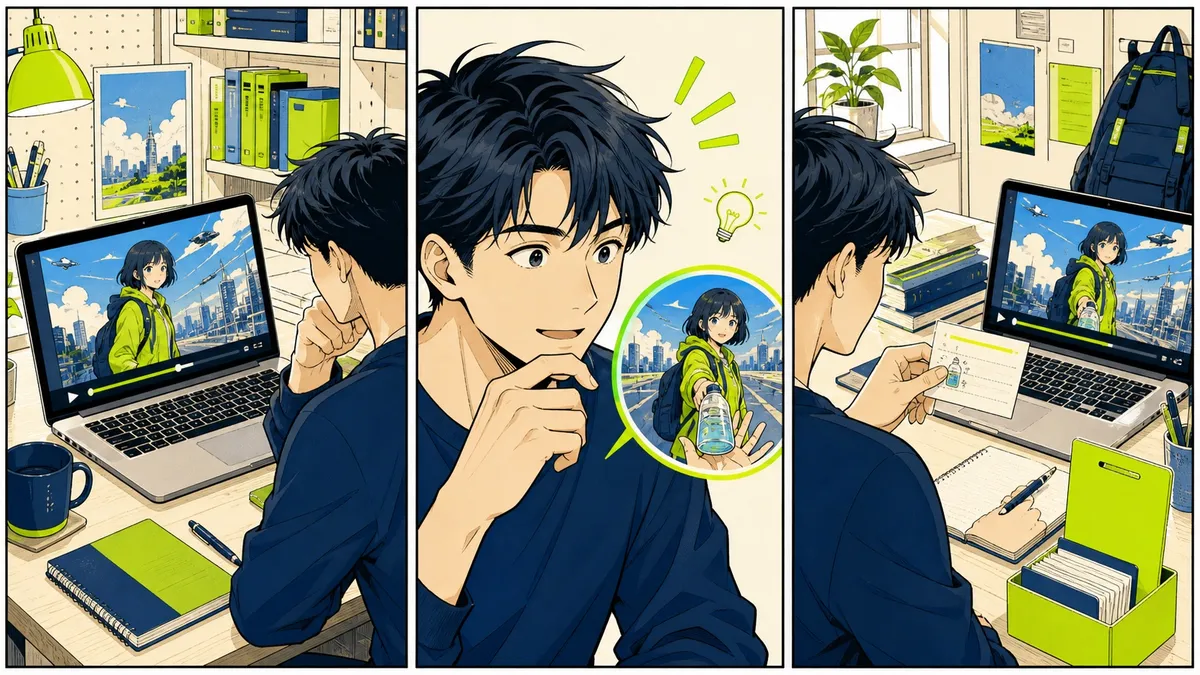
Japanese sentence mining from video works best as a short loop: watch, select, understand, save, and resume. The purpose is to make future Japanese easier to comprehend, not to extract the maximum possible number of subtitles. A useful workflow preserves the scene’s context while keeping research and formatting smaller than the learning itself.
That distinction matters at the start of a new school year. A complicated system feels exciting for three days and expensive for three months. Build the minimum version first, then automate only the steps that repeatedly waste time.
Begin with meaning, not a subtitle file
Watch a complete scene before capturing anything. Identify the event, relationship, and emotion. Then replay a short segment with Japanese subtitles when reliable subtitles are available.
Choose a sentence when:
- you understand the surrounding scene;
- the sentence has one important unknown or listening surprise;
- the wording seems reusable or personally memorable;
- the line is short enough to review as a single thought.
Skip lines dominated by names, lore, noisy recognition errors, or several unfamiliar grammar structures. Difficulty is not automatically value. The what is sentence mining guide explains the i+1 principle, while the anime sentence-mining guide focuses on character and register.
Starting from raw subtitle files reverses the priorities. It removes the visual and social evidence that made the sentence understandable, then invites you to collect lines because they exist rather than because they help.
Resolve only the gap that blocks the sentence
For each selected line, ask: what prevents understanding?
- If it is a word, check its meaning and role in this sentence.
- If it is grammar, read enough to explain the relationship between parts.
- If it is listening, compare the written form with the actual sound.
- If it is register, note who says it to whom and with what effect.
Stop when the sentence becomes clear. Opening six references can create the feeling of rigor while pulling you away from the original Japanese. Keep unresolved questions in a separate list; not every curiosity must become card content.
When working with YouTube automatic captions, remember that YouTube explicitly warns of caption errors caused by audio and speech conditions. Do not preserve an uncertain machine transcript as a trusted language model. Replay, verify, or skip it.
Save the smallest useful artifact
A practical comprehension card has:
- the complete Japanese sentence;
- a natural meaning rather than rigid word substitution;
- a reading only where it unlocks recognition;
- one short vocabulary, grammar, or register note;
- a cue that returns you mentally to the scene.
The card should answer one question cleanly. If it tests comprehension, do not also demand perfect spoken production. If you want to use the expression, create a separate output exercise and get feedback on appropriateness.
The Japanese Anki sentence-card guide offers field patterns, and the official Anki getting-started documentation explains how notes generate cards and enter scheduled review.
Anki is optional. You can keep three lines in a weekly note and replay their scenes on fixed days. Spaced repetition becomes useful when retrieval matters and you are willing to maintain the material; it is not a moral requirement for immersion.
Set a budget for present and future work
Every new card creates future reviews. Start with a budget of three sentences per focused session and three sessions per week. After two weeks, check:
- Did you complete the videos you started?
- Can you hear the saved phrases more clearly?
- Are reviews short and unambiguous?
- Did the queue displace listening or reading?
- Are you selecting better lines over time?
If the queue feels heavy, stop creating cards before optimizing scheduling settings. Repair or suspend weak material. The Anki and immersion balance guide can help protect the input that gives the cards meaning.
Sentence mining supports vocabulary, grammar noticing, and listening. It does not replace conversation partners, corrected writing, a JLPT plan, or professional training. Reserve time for the skill your real goal demands.
Let future automation return time to video
KIKUGO currently shortens the route from Japanese Netflix subtitles to explanations and Anki-ready material. YouTube and Crunchyroll support is coming, with no promised date. Those integrations are planned, not currently available.
The right automation preserves your decision: you choose the line; the tool reduces copying, lookup friction, and formatting. It should never turn a whole episode into an automatic backlog.
You may reserve 50% off your first annual year before the first public YouTube or Crunchyroll launch. The exact annual price will be communicated before purchase. After the launch email, you will have 30 days to activate the reserved offer; renewals use the normal annual price then in effect.
Run the five-step loop manually this September. When future support removes busywork, keep the same three-line ceiling. Efficiency is not extracting more. It is spending more of the evening understanding Japanese you wanted to watch.
Once a month, sample ten saved sentences and return to their sources. Classify each as immediately clear, clear after replay, or still confusing. Repair only the cards that remain valuable; suspend the rest. This source-based audit catches misleading translations and weak context that ordinary review can hide. It also reveals whether your selection is improving: strong mined sentences become easier both in the deck and in the living video where they began.
FAQ
What is sentence mining from video?
It is selecting contextual lines, resolving one focused gap, and preserving them for later retrieval.
How many lines should I save?
Begin with three or fewer per session and evaluate the review load after two weeks.
Is Anki required?
No. Scheduled replays or notes can work; Anki adds spaced retrieval when that serves your goal.