
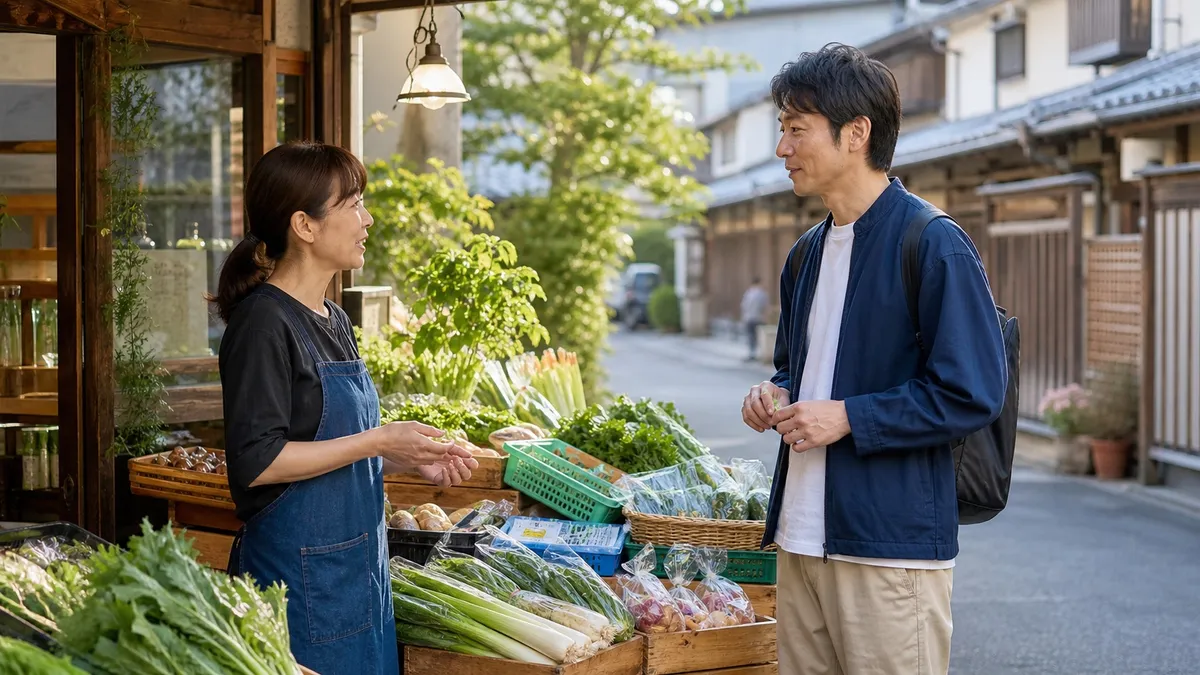
To talk to strangers in Japan respectfully, choose a setting where interaction has a shared purpose, open from what is happening, and give the other person an easy way to keep the exchange brief. Good Japanese helps, but timing, attention, reciprocity, and consent decide whether the conversation is welcome.
There is no single rule for all people or places in Japan. A neighborhood volunteer event, language exchange, guided activity, and quiet commuter train create different expectations. Treat the response in front of you as better evidence than a cultural slogan.
Choose contexts with a reason to speak
Approaching someone is easier when neither person must invent why the conversation exists. Useful contexts include:
- a class, tour, workshop, or volunteer activity;
- a community event with social time;
- a language exchange with explicit participation rules;
- a hobby group, sports club, or public meetup;
- asking a necessary question of staff;
- a shared delay, queue, or local situation where a short comment is relevant;
- an introduction through someone you both know.
Less suitable moments include someone wearing headphones, working, rushing, reading, managing children, or occupying a space where leaving would be difficult. Service staff may respond warmly because their job requires it; do not assume that warmth invites a longer personal conversation.
The Japan Foundation’s Irodori materials organize communication around real situations in daily life. Use them to rehearse practical exchanges while remembering that an exercise cannot guarantee a stranger’s availability.
Open from the immediate situation
The shared environment gives your words meaning. At a workshop, ask about the activity. At a local event, ask how someone heard about it. In a queue, limit yourself to information relevant to the queue. Avoid opening with a demand that someone explain Japanese culture, correct your grammar, or validate your interest in Japan.
A useful opening has three qualities:
- Relevant: it belongs to the present setting.
- Light: it does not require private information.
- Releasable: the person can answer briefly without social penalty.
Start with polite Japanese when speaking to an unfamiliar adult. Exact wording varies by situation, so learn functions rather than pretending one phrase is universally safe. The Japanese conversation starters guide provides context-to-follow-up patterns without turning the interaction into an interview.
Read the response instead of the stereotype
Signs that a conversation may continue include:
- a fuller answer than the question required;
- a question returned to you;
- attention remaining on the exchange;
- the person introducing another topic;
- an explicit invitation to continue or join.
Signs to close include:
- repeated minimal answers;
- eyes and body returning to another task;
- looking for an exit or companion;
- a language switch intended to complete the practical task quickly;
- a direct statement that they are busy;
- no engagement beyond professional courtesy.
None of these signals needs a theory about Japanese personality. People can be shy, tired, busy, interested, cautious, sociable, or simply focused. Respecting a short exchange is more socially skilled than forcing a longer one to meet your practice goal.
Keep the conversation reciprocal
After an answer, react to one detail, then choose either a connected question or a small share about yourself. Do not fire five questions without offering anything back.
For example, if someone mentions that they attend the workshop monthly, you might react, say it is your first visit, and ask what they enjoy making. The conversation remains anchored in a mutual activity. Questions about age, salary, dating, family plans, body, health, politics, or identity need a relationship and context that a first meeting usually does not provide.
The guide on how to make Japanese friends respectfully keeps nationality from becoming the main qualification for friendship. A stranger is a person with their own purpose, not an immersion resource.
Handle language choices without pressure
Someone may answer in English, simplify their Japanese, use translation, or ask which language is easier. They may want efficiency, enjoy English, feel responsible for helping, or simply follow the language they heard first. You cannot know without asking, and they do not owe you Japanese practice.
If the situation is social and the exchange is going well, you can briefly say that Japanese is okay for you or ask whether using Japanese is comfortable. Accept the answer. In practical or time-sensitive encounters, prioritize mutual understanding over protecting your learning plan.
If you miss something, use a repair strategy rather than pretending to understand. Ask for repetition, confirm the key detail, or admit the gap. Honest repair builds more trust than smiling through information that matters.
End as carefully as you begin
Prepare graceful closing functions:
- thank the person for the information or conversation;
- say it was nice to speak;
- return attention to the shared activity;
- mention that you need to move on;
- make any future invitation specific and easy to decline.
Do not request contact details merely because the conversation went well. If continued contact makes sense, offer a low-pressure option tied to the shared group or event. Accept hesitation or refusal immediately.
A successful exchange can last thirty seconds. You asked clearly, understood the answer, and left both people comfortable. Length is not the measure.
Prepare with scenes, then return to people
Japanese shows can help you notice openings, attention signals, polite distance, and closings. They also compress social reality for drama. Study what the line does and who uses it before borrowing anything.
Use the Japanese small talk guide to practice reaction and follow-up chains. KIKUGO can explain a selected Japanese Netflix subtitle in context, but it cannot grant social permission or decide that fictional speech fits a real stranger.
Try one practical line in the Japanese sentence explainer demo, verify its register, and adapt it to a real shared situation. If that preparation is useful, install KIKUGO. Then pay attention to the person, not the saved phrase.
FAQ
Is talking to strangers okay?
It depends on the situation and the person’s response. Prefer settings with a shared purpose.
How should I begin?
Open politely from something present and ask an easy, relevant question.
When should I stop?
Close when answers stay brief, attention moves away, or the person signals they are busy.
Can strangers be speaking practice?
Do not assign them that role. Use structured practice and let ordinary conversations remain mutual.