
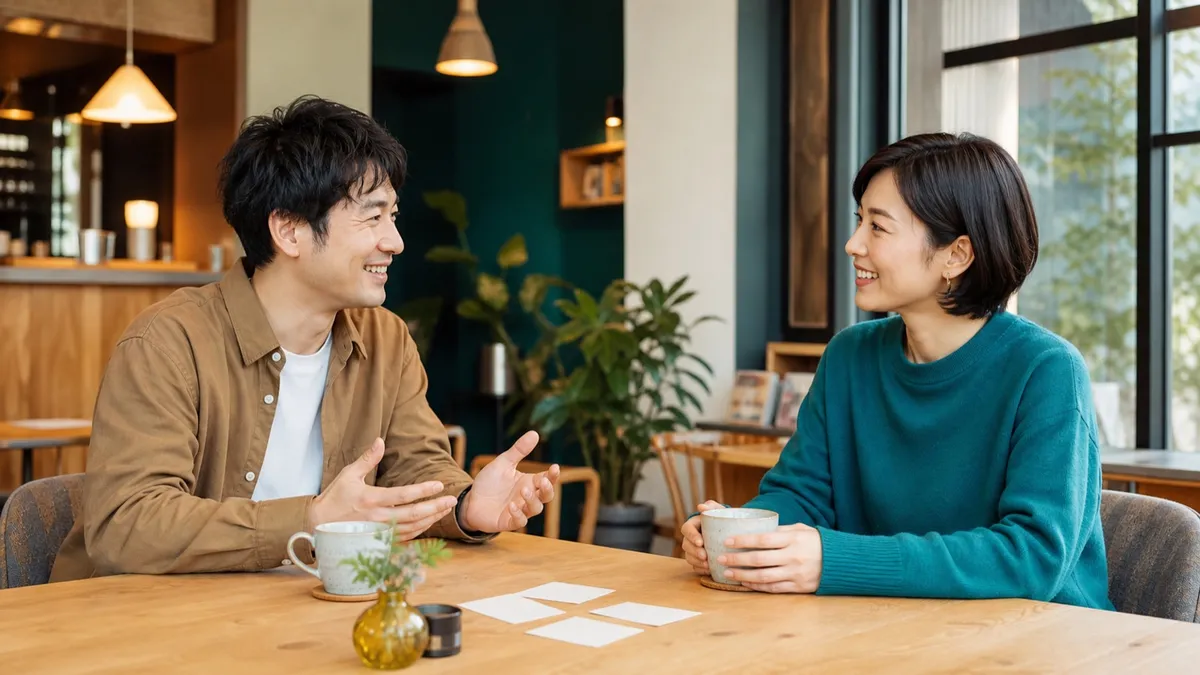
Good Japanese small talk follows a simple loop: notice something shared, ask an easy question, listen to the answer, react, and offer a related detail. The goal is not to perform a list of Japanese phrases. It is to make a short interaction comfortable enough for both people to continue—or leave naturally.
Use a September social reset to prepare three topics and three follow-ups, not thirty questions. Small talk should feel reciprocal, not an interview.
Start from shared context
The easiest topics are already present:
| Context | Opening direction | Follow-up direction |
|---|---|---|
| Class or event | How they found it | What interested them most |
| Cafe or meal | What they chose | Similar food they enjoy |
| Weather or season | A simple observation | Weekend or seasonal plans |
| Shared hobby | What they are making or watching | How they started |
| Neighborhood | Whether they visit often | Another place they like |
Avoid treating “Japan” as the only topic. Asking someone to represent an entire country creates work for them and reveals little about the person in front of you.
The Japan Foundation’s Irodori uses Can-do goals for everyday communication and emphasizes mutual understanding. That is a useful frame: what can both people accomplish together in this short exchange?
Use a three-part response
When someone answers, combine:
- Reaction: show that you heard.
- Follow-up question: ask about one detail.
- Small share: add something related about yourself.
Example structure:
- Reaction: そうなんですね。— Oh, I see.
- Follow-up: いつから始めたんですか。— When did you start?
- Share: 私も最近ちょっと興味があって…。— I have been getting interested recently too…
Exact wording changes with formality and relationship. The structure matters because it prevents a sequence of disconnected questions.
Practice a follow-up question for each prepared topic. If someone says they watched a movie, ask what they liked before switching to your next card.
Keep topics safe and adjustable
Useful early topics include food, hobbies, media, the event, local places, study, work in broad terms, and near-future plans. Personal boundaries differ. Follow the other person’s level of detail and do not assume all Japanese people share one comfort zone.
Be cautious with:
- income and finances;
- romantic status or family plans;
- age, body, health, or appearance;
- politics and religion;
- stereotypes about nationality or gender;
- requests for free teaching, translation, or access.
A person can decline, answer briefly, or change topic. Read that as information, not a challenge to ask more cleverly.
The guide on making Japanese friends respectfully keeps shared interest and boundaries larger than language practice.
Prepare repair and exits
Small talk becomes less stressful when you can repair:
- もう一度お願いします。— One more time, please.
- 〜ってどういう意味ですか。— What does ___ mean?
- つまり、〜ですか。— So, is it ___?
Prepare graceful transitions and exits too:
- そういえば…。— Speaking of which…
- お話しできてよかったです。— It was nice talking with you.
- そろそろ行かないと。— I should get going soon.
Choose wording that fits the relationship. Leaving naturally is part of conversation competence.
If nervousness blocks retrieval, Japanese speaking anxiety offers a ladder from prepared answers to unpredictable exchange.
Learn reactions from scenes, then verify them
Shows are useful for observing aizuchi, timing, overlap, tone, and how friends build on a topic. A subtitle translation may remove small reactions because they sound repetitive in English.
Use one exchange:
- notice who initiates and how;
- identify the listener’s reactions;
- see which detail creates the next question;
- check register and relationship;
- adapt the topic, not the character’s identity.
KIKUGO’s Japanese subtitle explanations can help with a complete line. It cannot tell you that every fictional phrase belongs in your situation, and it cannot replace a willing conversation partner.
The guide to understand casual Japanese conversation focuses on reductions, turn-taking, and implied context.
Practice with reciprocity
Bring two topics to a lesson or Japanese language exchange. Ask what your partner wants to discuss and how corrections should work. Give their target language equal attention.
Afterward, keep one reaction, one follow-up, and one correction. A conversation is not raw material to harvest. The purpose is communication.
Practice the listener role
Small talk is not measured only by how long you speak. Replay short exchanges and focus on the listener: where do they react, ask for detail, laugh, pause, or let the topic close? Record yourself responding to the same story with three levels of formality. Then ask a teacher or partner which reactions sound attentive and which feel exaggerated. Becoming easier to talk with can matter more than producing a longer monologue.
Japanese small talk becomes natural through many ordinary exchanges, not one perfect list. Notice, ask, listen, react, share, and let the other person choose how far the topic goes.
For situation-specific openings with likely replies and connected follow-ups, use the Japanese conversation starters guide. Treat each starter as an invitation, then return attention to the answer.
To study one contextual reaction before practice, try the KIKUGO demo. If that helps without replacing interaction, install KIKUGO.
FAQ
What are good Japanese small talk topics? Use the shared setting, food, season, plans, hobbies, or media and follow the person’s level of detail.
How do I keep the conversation going? React, ask one connected follow-up, and share a related detail.
What topics should I avoid? Avoid intrusive personal topics unless the relationship clearly supports them.
How can I practice alone? Rehearse short topic chains and reactions, then use them with a willing partner.