
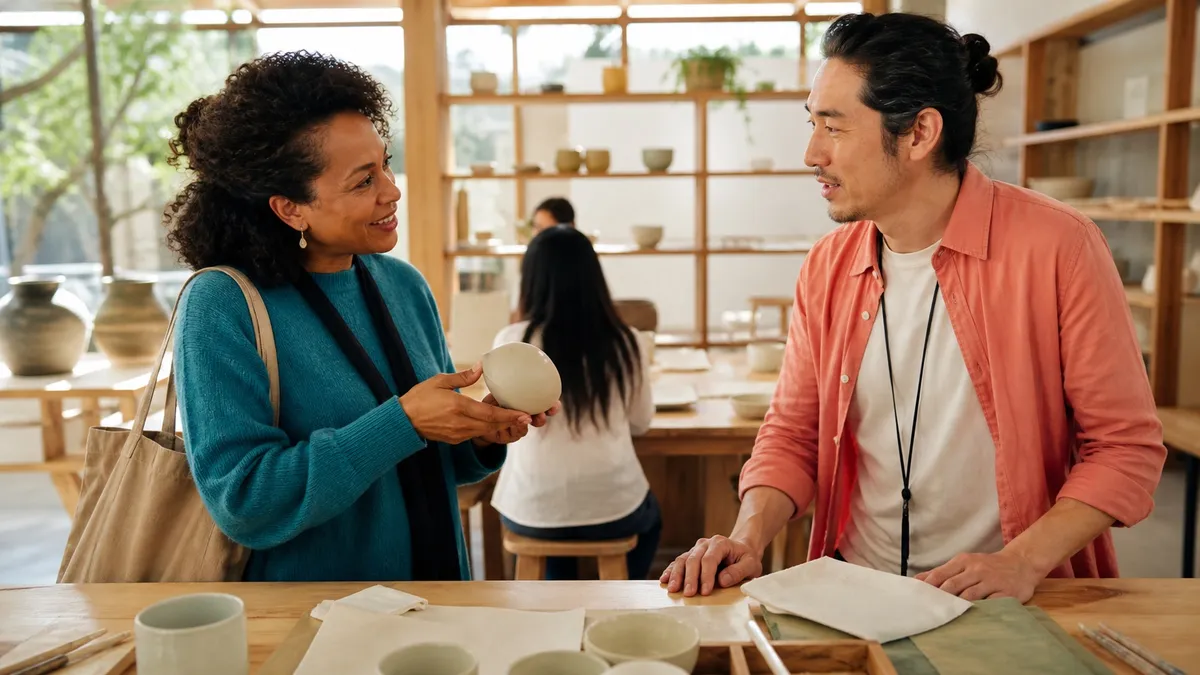
The best Japanese conversation starters begin with a reason to talk, not a clever sentence. Notice something you genuinely share, ask one easy question, listen to the answer, react, and offer a related detail about yourself. That five-part loop feels more natural than delivering unrelated questions from a phrase list.
Use these starters at events, classes, language exchanges, host-family meals, or hobby groups where conversation is already welcome. They are not permission to interrupt anyone who happens to be Japanese. Context and reciprocity matter more than perfect grammar.
Start with what is already shared
A shared setting removes much of the social guesswork. Instead of asking a stranger to explain Japan, ask about the thing both of you chose to do.
| Setting | Opening direction | Likely answer | Connected follow-up |
|---|---|---|---|
| Workshop | How they found the event | Friend, website, local notice | Whether they attend often |
| Language exchange | What they want to practice | Travel, work, hobby | A situation where they use it |
| Food event | What they tried | A dish or ingredient | Another place they recommend |
| Film or anime group | What they liked | Character, scene, theme | Why that detail worked for them |
| Neighborhood activity | Whether they live nearby | Area or commute | A local place they enjoy |
These are directions, not scripts. Choose Japanese that fits your ability and the level of politeness. If a person gives a short answer without adding detail, do not treat it as a puzzle you must overcome.
The Japan Foundation’s Irodori course models practical interactions around daily-life goals. Study the complete exchange around an opening, including the response and closing, rather than memorizing the first line alone.
Use an opener, reaction, share, and follow-up
Imagine someone says they joined the event because a coworker recommended it. A natural next turn has options:
- react to the recommendation;
- ask whether the coworker is also attending;
- mention how you discovered the event;
- ask what part interested them.
You do not need all four. Choose one reaction and one connected move. This proves you heard the answer and gives the other person something about you to respond to.
The existing Japanese small talk guide explains this reciprocal structure in depth. Use the starter list here as an entrance, then rely on listening rather than searching mentally for item two.
Prepare starters by situation
At a class or workshop
Ask about the shared task: whether it is their first time, what they found difficult, or what they hope to make. A visible activity supports meaning when your Japanese fails. Avoid demanding that the person become your teacher simply because they are a native speaker.
At a language exchange
Ask what each person wants from the session and how corrections should work. Then choose an ordinary topic: a recent meal, weekend plan, hobby, or show. The Japanese language-exchange tips help divide time fairly and keep consent explicit.
With a host family or local contact
Ask about the immediate routine: timing, preferences, plans, or something you can help with. Share your own needs clearly instead of guessing at unspoken rules. Gratitude is useful; exaggerated praise and constant comparisons are tiring.
At a hobby or community event
Ask how someone became interested, what they enjoy about the activity, or what a beginner should notice. The shared interest should remain larger than language practice.
After someone introduces you
Use the introducer’s context. Ask how the two people know each other or mention the activity that brought everyone together. Avoid immediately asking age, relationship status, salary, or questions that make one person represent a whole country.
Learn the reply, not only the question
Phrase lists often stop at your line. Real conversations start there. For each starter, prepare three kinds of reply:
- a positive answer with detail;
- a brief or uncertain answer;
- a question returned to you.
Record a 30-second response to each. If you ask what someone enjoys watching, be ready to understand one title, a genre, “not much lately,” or “what about you?” Prepare how you will share your own answer without turning it into a speech.
This is especially important when familiar words arrive in reduced speech. The guide to understanding casual Japanese conversation helps you hear contractions, omitted information, and listener reactions in full scenes.
Keep boundaries visible
Conversation starters are invitations, not obligations. Useful signals that an exchange can continue include a fuller answer, a returned question, relaxed attention, or the person introducing a new topic. Signals to stop include repeated short answers, attention returning to another task, physical movement away, or an explicit need to leave.
Do not generalize one response into a rule about “Japanese people.” Personality, setting, time pressure, language preference, and simple mood all matter. A graceful ending is successful communication.
Useful closing functions include thanking the person, saying it was nice to talk, returning attention to the activity, or making an easy-to-decline suggestion to talk again. Practice endings alongside openings so neither person has to invent an escape.
Turn scenes into personal starters
Shows can demonstrate how friends react, how coworkers soften a question, or how strangers open around a shared situation. They can also contain theatrical, intimate, rough, or character-specific language.
Choose a short exchange and ask:
- Why was speaking appropriate here?
- What did the opener assume both people shared?
- How did the listener show interest or distance?
- Which follow-up came from the actual answer?
- What would you change for your own identity and setting?
KIKUGO can explain a selected Japanese Netflix subtitle line, including grammar and nuance. It cannot determine whether a person wants to talk or make a fictional relationship match yours. Try one line in the Japanese sentence explainer demo, adapt the conversational function, and install KIKUGO if contextual preparation helps.
Prepare three starters for one real setting, plus likely replies and one graceful ending. Then put the list away. The moment someone answers, the conversation belongs to both of you.
FAQ
What are good starters?
Ask about a shared activity, place, meal, hobby, or event and follow the answer.
How should I approach a stranger?
Choose a context where interaction is welcome, begin politely, and respect brief replies.
Polite or casual Japanese?
Start politely with an unfamiliar adult and let the relationship guide any change.
How do I avoid an interview?
React, share something related, and ask fewer connected questions.