
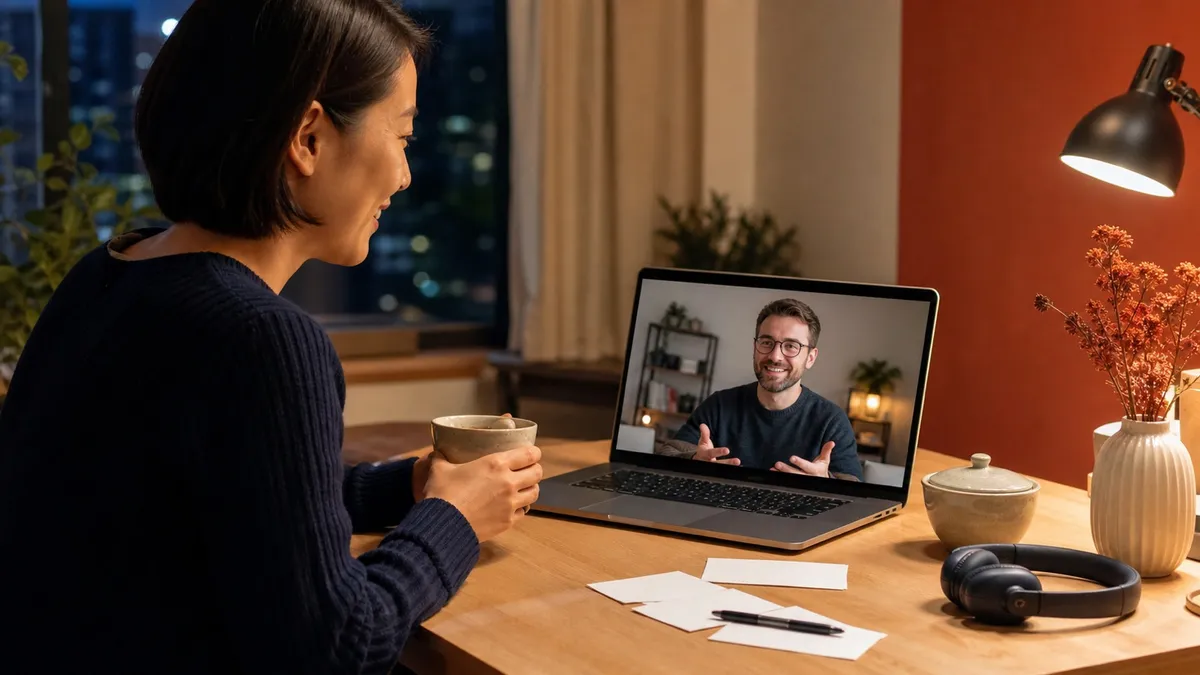
The best Japanese language exchange tips are not tricks for sounding fluent. They help two people create a fair conversation where both languages, goals, and boundaries matter. Prepare a small topic, agree on time and corrections, use repair phrases when you get lost, and leave space for curiosity.
Netflix dialogue can give you something concrete to bring: a reaction, a casual phrase, or a question about tone. KIKUGO can help you understand and save that line beforehand. It cannot create the relationship for you. People are not practice tools, and a language exchange works only when both partners receive value.
Prepare a conversation, not a speech
Bring a small preparation card with:
- two topics you genuinely want to discuss;
- three Japanese chunks you want to retrieve;
- one follow-up question for each topic;
- two repair phrases for when you miss something;
- one question about usage or nuance.
Good topics have a shared object: a food photo, a hobby, weekend plans, or a scene both people can discuss. “Tell me about Japan” asks your partner to invent the entire conversation. “In this scene, why does the friend use じゃん here?” gives both people something specific to notice.
If word-by-word English keeps delaying your response, how to think in Japanese shows how familiar chunks can connect directly to meaning. The wider Japanese conversation practice guide adds shadowing and repair strategies.
Prepare Japanese small talk as connected reactions and follow-ups, use a smaller ladder when Japanese speaking anxiety blocks retrieval, and keep the wider goal of making Japanese friends respectfully separate from obtaining free language practice.
Agree on the exchange before starting
Clarify four details:
- How long will you talk?
- How will you divide Japanese and the other language?
- What kind of correction does each person want?
- Is the session text, voice, video, or a mix?
A simple 40-minute structure is:
| Time | Language | Focus |
|---|---|---|
| 0–5 min | Shared | Check goals and warm up |
| 5–20 min | Japanese | One prepared topic and follow-ups |
| 20–35 min | Partner’s target language | Their topic and follow-ups |
| 35–40 min | Shared | Corrections, next topic, scheduling |
Equal time is a useful default, not a rigid law. The important part is explicit agreement rather than one person quietly becoming the teacher.
Ask before correcting. One partner may want immediate pronunciation feedback; another may want uninterrupted speaking and three notes afterward. Consent makes correction useful rather than exhausting.
Tofugu’s detailed language exchange guide also emphasizes preparation, useful facilitator phrases, and making the exchange work for both participants.
Use repair phrases instead of pretending
Understanding half a sentence and smiling can feel safer than interrupting. It also blocks the exact skill a real conversation needs: repairing a gap together.
Practice chunks such as:
- もう一度言ってもらえますか。— Could you say that again?
- もう少しゆっくりお願いします。— A little more slowly, please.
- 〜というのはどういう意味ですか。— What does ___ mean?
- つまり、〜ということですか。— So, do you mean ___?
- うまく言えないんですが…。— I cannot express it well, but…
Choose wording appropriate to your relationship and level. The point is not to memorize a perfect list; it is to remain in the interaction when comprehension breaks.
The Japan Foundation’s Irodori approach centers practical communication tasks for life in Japan. Repairing, checking, and responding are part of communication—not evidence that the conversation failed.
Turn a Netflix line into a speaking bridge
Use this preparation loop:
- Choose one line from a scene whose situation you understand.
- Inspect the grammar, omitted subject, and register.
- Save the full sentence with its context.
- Replace one detail to make it true for your life.
- Bring the adapted version and a related question to the exchange.
For example, a character’s reaction to a difficult week can become a way to describe your own week, then ask your partner what they do to relax. The scene supplies emotional and social context that a random vocabulary list cannot.
KIKUGO’s Japanese subtitle explanations can support the preparation step. The Japanese listening practice hub provides more ways to connect replay, shadowing, and retrieval before live interaction.
KIKUGO is not a conversation partner and does not replace feedback from a real person. It also does not guarantee friendship, romance, or belonging. Those outcomes depend on mutual interest, trust, time, boundaries, and circumstances beyond language ability.
Keep the relationship larger than the lesson
Language exchange can become transactional when every message is a correction request. Show interest in the person, remember previous topics, respect delayed replies, and do not turn cultural identity into an interview.
Useful habits include:
- ask what your partner wants to practice;
- bring corrections in the language they are learning too;
- avoid unsolicited flirting or pressure to move platforms;
- accept that some exchanges will not become friendships;
- stop when boundaries or expectations do not match.
If both people enjoy a shared show, book, game, or hobby, let that interest carry the conversation. Japanese becomes the medium for a real topic rather than the only reason to interact.
Leave with one reusable result
After the exchange, keep one expression you heard, one correction you understand, and one question for next time. Do not turn the session into 40 new cards. The subtitle-supported listening routine can help you reinforce the same sound or pattern between conversations.
Learners preparing for a stay can compare official classes, conversation salons, tutors, exchanges, and hobby groups in the guide to where to practice Japanese in Japan. Use structured settings when feedback is the goal.
Ready to prepare one contextual line for your next exchange? Try the KIKUGO demo and install the extension, then bring the adapted sentence to a real conversation.